So, the Changes to Make City Councilor and School Committee Member Terms 4 Years Might Not Be Going to the Voters After All?

Moving away from School Committee coverage for now, I want to focus on something that has not been on most people’s minds since fall of last year: the amendments to the City of Pittsfield’s Charter that the City Council proposed and passed, primarily regarding moving to 4 year terms for School Committee members and City Councilors.

Back in August, the City Council voted to petition the State Legislature with two Special Act amendments to the City Charter to increase the terms of City Councilors and School Committee members from 2 years to 4 years, in line with the Mayor. This was billed as a way to make local government more stable as well as to save money by not having to run a local elections as often.

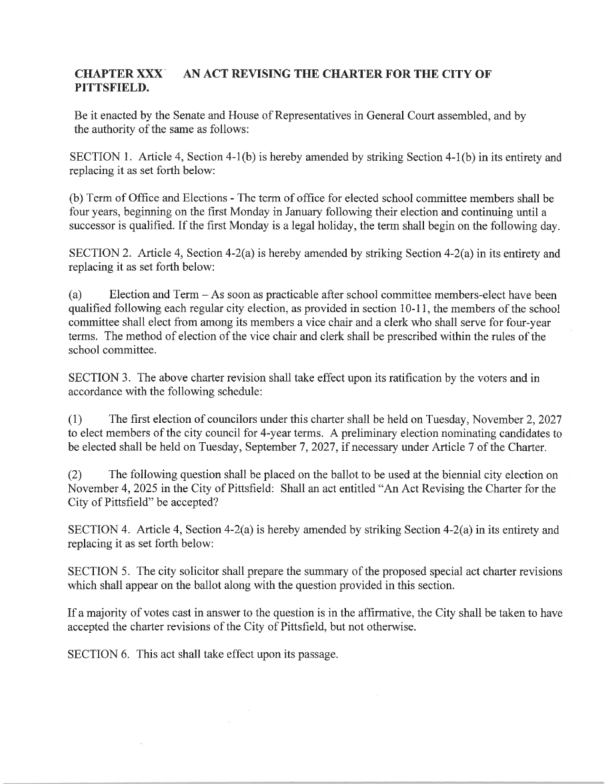
Here is the proposed Special Act for making School Committee member’s terms 4 years:
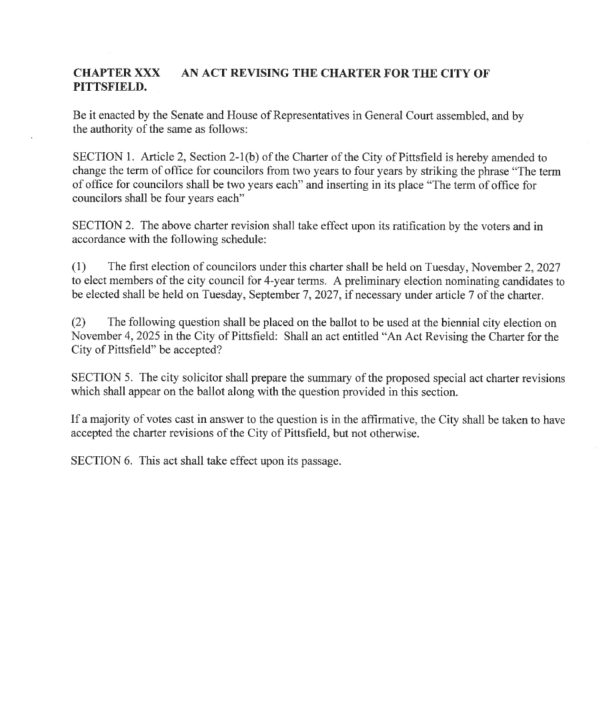
And here is the proposed Special Act for making City Councilor’s terms 4 years:
The process for a Special Act amendment is the City Council votes to approve the charter amendment, then it goes to the State Legislature as a bill to get approved through the normal legislative process where bill has to pass the House and Senate then get signed into law by the Governor.

The amendment doesn’t automatically go to the voters, unless the City Council and/or the State Legislature specifically includes language putting it on a ballot. The City Council did include such language in both petitions.

However, the bill introduced by Rep. Farley-Bouvier to amend the Charter (Bill H.4716) does not contain any provision for the changes to go before the voters. The bill’s language is much simpler than what the voters approved, only requiring the two references in the charter to change the School Committee and City Councils terms from two years to four years. Nothing about it going before the voters. Nothing about when it will come into effect.

SECTION 1. Subsection (b) of section 2-1 of article 2 of the charter of the city of Pittsfield, which is on file in the office of the archivist of the commonwealth pursuant to section 12 of chapter 43B of the General Laws, is hereby amended by striking out the word “two” and inserting in place thereof the following word:- four.

SECTION 2. Subsection (b) of section 4-1 of article 4 of said charter is hereby amended by striking out the word “two” and inserting in place thereof the following word:- four.

This presents a major problem. The Council voted under the assumption that these changes would be going before the voters. I would say most residents and voters in Pittsfield, in favor or opposed to the change, were under the assumption that these changes would be going before the voters as well. Based on my interpretation of the language of the bill, City Councilor and School Committee member terms will be serving 4 year terms starting with the members elected in the 2027 Municipal Election.

And the worse part, the bill has already passed the house. I’ve been tracking this bill for a while now, and I thought the House Committee on Bills in the Third Reading, which catches drafting issues with bills, would catch this error. They did not.

Right now the bill sits in the Massachusetts Senate, and seems to be very close to getting passed and being sent to the Governor for her to sign (which will most likely happen).

So is this Legal?

This is the part where I am unsure, partially because I’m not a lawyer and that I don’t have all of the behind the scenes information about how the bill was drafted.

From my understanding, the Massachusetts Constitution Article LXXXIX provides the steps for a Municipality to petition the state legislature to change its Charter:

Section 8. Powers of the General Court. – The general court shall have the power to act in relation to cities and towns, but only by general laws which apply alike to all cities or to all towns, or to all cities and towns, or to a class of not fewer than two, and by special laws enacted (1) on petition filed or approved by the voters of a city or town, or the mayor and city council, or other legislative body, of a city, or the town meeting of a town, with respect to a law relating to that city or town; (2) by a two-thirds vote of each branch of the general court following a recommendation by the governor; (3) to erect and constitute metropolitan or regional entities, embracing any two or more cities or towns or cities and towns, or established with other than existing city or town boundaries, for any general or special public purpose or purposes, and to grant to these entities such powers, privileges and immunities as the general court shall deem necessary or expedient for the regulation and government thereof; or (4) solely for the incorporation or dissolution of cities or towns as corporate entities, alteration of city or town boundaries, and merger or consolidation of cities and towns, or any of these matters.

Based on this, the only way the Legislature can change the City Charter is either through a petition approved by the City Council and Mayor, or by a 2/3rds vote of both branches based on a recommendation from the Governor. As the latter has not happened from my understanding, the change is being enacted based on the Council’s petitions to the State Legislature.

However, the language the Legislature is passing is not in line with what the Council approved, so from my understanding this bill wouldn’t be Constitutional as it is not going through the proper process of amending the City Charter.

Though there is one caveat, part of the Order the Council passed stated the following:
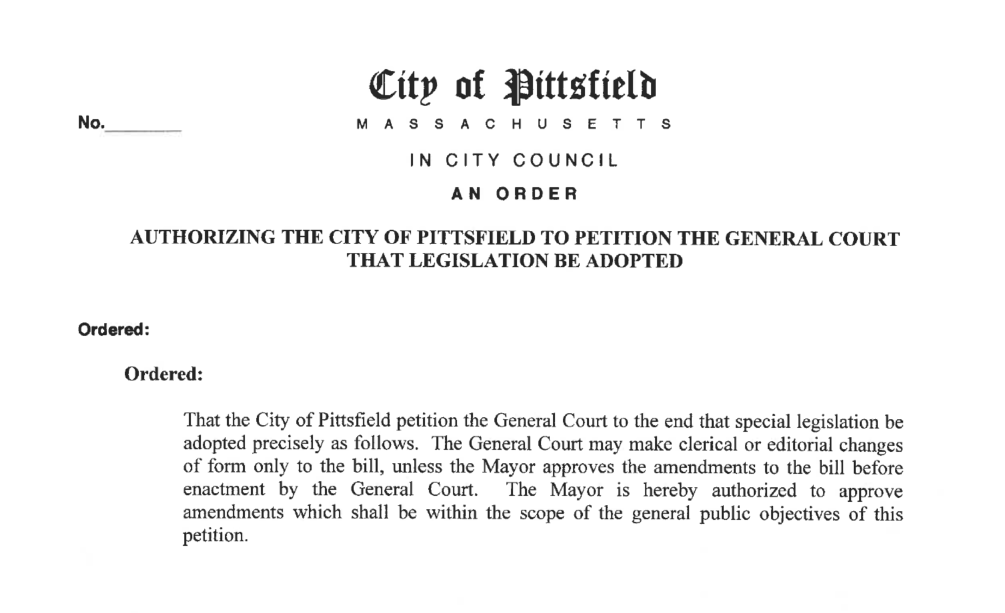
Based on my reading of the order any amendment to the proposed Special Act to have it not go before the voters would not “be within the scope of the general public objectives of this petition” as one of the primary objectives, in my view, is that the voters would be able to decide if Councilors and School Committee members serve 4 year terms or not.

Additionally, another wrench in all of this is that as the process of getting a Special Act approved is slow, when the Council approved the original two petitions they became out of date as the Council was looking to put both questions on the ballot for the 2025 election, which did not happen. So an amendment would have needed to be made to have the question be put on the 2027 ballot. So I’m not sure if the discussion between the Mayor and the Legislature resulted in the bill being amended so that it wouldn’t go to the voters at all. But I feel that would mean the change was very much out of scope of what the Council originally passed.

So, What Now?

I’m hopeful that this blog post will catch people’s attention to this issue, and hopefully ensure that someone in the Legislature calls attention to the issue and ensures this issue does go before the voters.

If you feel the same way that I do that this should go before the voters, I would highly recommended reaching out to Rep. Farley-Bouvier or Senator Paul Mark, who both represent Pittsfield. There contact information is below.

Representative Tricia Farley-Bouvier: Tricia.Farley-Bouvier@mahouse.gov

State House

24 Beacon St.
Room 274
Boston, MA, 02133

Phone: (617) 722-2676

District Office

Phone: 413-442-4300

Senator Paul W. Mark: Paul.Mark@masenate.gov

State House

24 Beacon St.
Room 504
Boston, MA, 02133

Phone: (617) 722-1625

District Office

773 Tyler Street
Pittsfield, MA 01201

Phone: 413-464-5635
Some Thoughts About the Pittsfield School Committee Election

Last month the City Council voted, again, to ask the School Committee to release redacted versions of the PHS Investigation Reports. The next day, the new School Committee voted 6-1 to also release a redacted version of the reports.

I’m not going to get into my thoughts about this, partially because that itself deserves its own blog post that I’m not sure I’m ready to write just yet. However, I want to push back on an argument Councilor Warren made in supporting this vote that “there is no confusion in the
publics vote in the November election, they want transparency” (page 11 of the City Council packet that contained the minutes of this meeting), inferring that the voters wanted the report released and voted accordingly in the election.

I do not buy this argument as I believe the voters were not given much of a choice this past election. Most of the candidates either supported releasing the report (Batory, Muil, Buerger, Smith, and Barry) or didn’t say much about their support or opposition (Klein and McNeice). There were only two candidates who supported the past School Committee’s decision to not release the full PHS, Elias (who ultimately voted against the motion to release the report) and Yon (while she supported the motion she seemed to support the Committee’s handling of PHS during the election). If voters wanted to elect School Committee members that were happy with how the School Committee handled the PHS incidents, then they were out of luck.

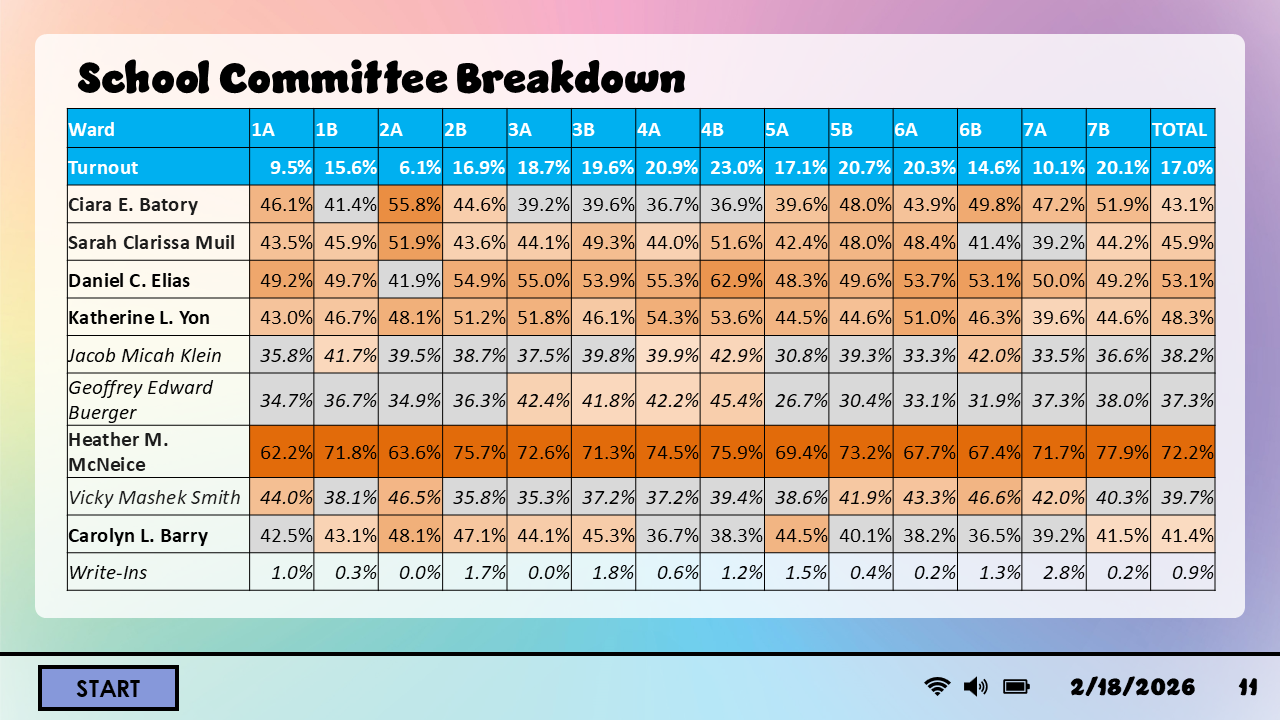
This argument also falls apart when you take a deeper look at the election results, which is what I did for a talk I gave to the MCLA Political Science Club.

As you can see, McNeice was the highest vote getter, and was the highest vote getter in every precinct. I would argue that this support came from being very well known in the community for being a long time Taconic teacher. In 2nd and 3rd place overall were Elias and Yon. Already this refutes the claim that the voters were clear about their views on the PHS report because if that were the case then Elias and Yon wouldn’t have been high up, if elected at all.

But to get a better understanding of this support, you need to look deeper. Looking at the second place winner in each precinct, Elias was the 2nd place winner in every precinct except for 2B, where he was in 7th place, and 7B where he was in 3rd place. In both of those precincts Batory was the 2nd place winner. If there was true, widespread support of releasing the full PHS report and dislike of the School Committee’s handling of the PHS incidents, then Elias would have not been the 2nd place winner in these many precincts.

Taking a look at the 3rd place winners in each precinct, Yon was the 3rd place winner in 6 precincts, 1B, 2B, 3A, 4A, 4B, and 6A, and tied with Barry in 5A. Batory was the 3rd place winner in 3 precincts, 1A, 6B, and 7A, and tied with Muil in 5B. Muil was the 3rd place winner in 2 precincts, 2A and 3B, and ties with Batory in 5B. Elias was the 3rd place winner in 7B. I feel these results show a more mixed picture of what voters wanted in a School Committee in this election.

Additionally, if you take a look at Sara Hathaway’s numbers in her unsuccessful at-large councilor bid, she got 2761 votes, more votes than every school committee candidate except for McNeice and Elias. If voters were this dissatisfied with the former School Committee’s handling of the PHS reports, Hathaway would have not had such a large vote count even for an at-large councilor seat.

Ultimately, I think these election results really show two common themes in local politics: voters tend to prefer incumbents and familiar faces. No incumbent lost their seat this last election, and in the 2023 Pittsfield election only one incumbent lost their seat. For the amount of criticism both the city government and the school department get on places such as Facebook and the Berkshire Eagle, voters who show up to vote tend to be happy with the current state of local government in Pittsfield. I don’t feel these results really show support for any certain agenda or mandate to do something, voters just like stability and familiar faces in government.

No, There is No State Law Saying the Mayor Should Be Chair of the Pittsfield School Committee

Since my letter to the editor regarding the Council’s actions regarding making the Mayor Chair of the Pittsfield School Committee, an argument has been swirling around that there is a state law that says the mayor should be chair of the school committee, which Pittsfield is not following.

More specifically, the law being mentioned is Massachusetts General Law Chapter 43 Section 31. In fact, the law does state “The school committee shall consist of the mayor, who shall be the chairman, and six members elected at large.” On a first reading, it does sound like the Mayor, by law should be chair. Pittsfield has a six member school committee, elected at large, with the Mayor also being there as well, so under this law they should be chair, right?

However, context is important here. Chapter 43 primarily deals with a certain type of City Charters know as “plan charters”. They consist of Plan A through Plan F which have different structures of government. Cities can adopt these plan charters through a process outlined in that chapter, where they basically follow the provisions in Chapter 43. Cambridge is one such city, where their charter is basically excerpts from MGL.

While Pittsfield has a structure of government that aligns with what a Plan B Charter would look like, which as MGL states is “a city government and legislative body composed of a mayor and city council, the councillors being elected partly at large and partly from districts or wards of the city”, and Pittsfield is commonly referred to as a Plan B form of government, Pittsfield does not have a Plan B charter. Instead, we have a special act charter, approved by Chapter 72 of the Acts of 2013.

A special act charter allows to have a different form of government than what is outlined in MGL, such as having a separate chair of a school committee, or have differently sized school committee and city council. It allows for a structure of government that serves what Pittsfield thinks is best, not what the state thinks its best. This is best shown by the fact that Pittsfield’s charter is not just excerpts of MGL.

And if it were the case that Pittsfield had to comply with the provisions in Chapter 43 (which we do not have to), then there would be other issues than just having a non-mayor chair of the School Committee:

  • The City Clerk would not be elected, instead appointed for a 3 year term by the City Council (Section 18)
  • School Committee members would have 4 year staggered terms (Section 31)
  • The City Council would have to vote to appoint a Council President every year, not every two years currently (Section 59)
  • If there was a vacancy in a ward councilor seat, that vacancy would have to be filled by a special election, which is not the case in Pittsfield (Section 59A)

Unless Pittsfield wants to adopt a straight Plan B charter (which most cities are moving away from anyways), then we do not have to follow the provisions of Chapter 43.

Letters to the Editor Regarding Making Mayor the Chair of the Pittsfield School Committee

Last week I submitted a Letter to the Editor regarding the City Council Proposal to amend the City Charter to make the Mayor automatically chair of the Pittsfield School Committee. Another Letter to the Editor written by Councilor at Large Earl Persip appeared in the paper earlier this week. Both letters can be viewed below.

Be on the lookout for another blog post detailing more about this proposal, and my questions/concerns about everything going on.

Letter: Pittsfield city charter changes should go before voters

Aug 22, 2025

To the editor: Before I spoke at the last City Council meeting against the proposed amendment to the city charter making the mayor chair of the Pittsfield School Committee, Councilor Kenneth Warren made a comment to me that there was not much of a point in speaking against the proposal as it would be going to the voters. (“Longer terms for city councilors and School Committee members could be on the November ballot, pending state approval,” Eagle, Aug. 15.)

Undeterred, I still decided to speak out against it.

Later on during the meeting, I became confused and then appalled when Councilor Warren made an amendment so that this change would not go to the voters. Why the sudden shift between before I spoke during public comment and the discussion on the amendment?

In a now deleted Facebook comment thread, another city councilor stated that this amendment doesn’t need to go to the voters as he believes the council knows what is best for the city, and that this would address what the council sees as issues with working with the School Committee.

I strongly disagree with this sentiment. The voters of this city voted back in 2013 to adopt the current version of the charter, and they should be the ones who decide what parts get changed and which parts remain. This is the voter’s charter, not the City Council’s to play around with.

The law even agrees. The statute the council is using to make this amendment says: “Whenever an order proposing a charter amendment to the voters is approved by the mayor and city council … a copy of the proposed amendment shall be immediately submitted to the attorney general…” So then, why does the City Council believe it has a mandate, let alone the authority, to make changes to the city charter without voter approval?

While I believe this proposal is misguided and very problematic, if the voters want to make the mayor chair of the Pittsfield School Committee, then they can vote to support the amendment at the ballot box. Not letting the voters decide on such an important matter would be a disservice to the city’s voters.

The more I hear about the council’s rationale for not sending this amendment to the voters, the more I fear that this is a hostile power grab by city leaders to micromanage the school department budget and its operations, potentially leading to devastating budget cuts. This power grab can and should be stopped at the ballot box.

William Garrity, Pittsfield
The writer is a Pittsfield School Committee member.

Letter: A response to letter-writer’s concern on charter change proposal

Aug 26, 2025

To the editor: The Aug. 22 letter “Pittsfield city charter changes should go before voters” misrepresented both the process and the purpose of the proposed charter amendment.

This is not a power grab. It is about accountability. The mayor is already responsible for presenting and balancing the city’s overall budget, which includes the schools. Having the mayor serve as chair of the School Committee aligns that responsibility with clear leadership. Several Massachusetts cities already follow this structure.

The City Council is acting fully within its legal authority. Massachusetts law allows charter changes either through a commission process that goes to the ballot or through a council-approved petition sent to the Legislature. Both are legitimate. We are using the process the law provides.

Voters are not being cut out. Any charter change must go to the Legislature and then back to the city for acceptance. There are multiple levels of oversight built in.

What cannot be ignored is the past year. The Pittsfield High School investigation exposed a clear lack of accountability from the School Committee when serious problems surfaced. Parents, students and taxpayers expected openness. Instead, they saw delays, secrecy and excuses. The state itself ordered portions of the report released after ruling the district failed to justify withholding it. That is not what voters expect from their elected representatives.

This proposal to make the mayor the School Committee chair responds to those concerns. Transparency, collaboration and financial oversight have been missing. When the School Committee is not aligned with city government, it creates confusion and mistrust. Giving the mayor a defined role as chair creates accountability at the top, which benefits students, teachers and taxpayers.

The council is doing its job: debating policy, weighing options and making decisions in the best interest of the city.

Earl G. Persip III, Pittsfield
The writer is an at-large councilor and vice president of the Pittsfield City Council.

Emailed Comments to City Councilors Regarding Term Limits and School Committee Age Requirement Petition

Dear Councilor,

I hope you are doing well. As I am taking a course at Berkshire Community College on Tuesday and Thursday evenings throughout June, I am unable to attend the public comment period at the June 13th City Council meeting. Therefore I am sending my comments to all councilors via email before the meeting.

I am still recommending that the City Council file the petition regarding term limits for public office, which was charter objected at the May 24th meeting.

After sitting through the deliberation on this problematic petition, I want to respond to two major arguments that were brought forth.

Continue reading “Emailed Comments to City Councilors Regarding Term Limits and School Committee Age Requirement Petition”