Moving away from School Committee coverage for now, I want to focus on something that has not been on most people’s minds since fall of last year: the amendments to the City of Pittsfield’s Charter that the City Council proposed and passed, primarily regarding moving to 4 year terms for School Committee members and City Councilors.
Back in August, the City Council voted to petition the State Legislature with two Special Act amendments to the City Charter to increase the terms of City Councilors and School Committee members from 2 years to 4 years, in line with the Mayor. This was billed as a way to make local government more stable as well as to save money by not having to run a local elections as often.
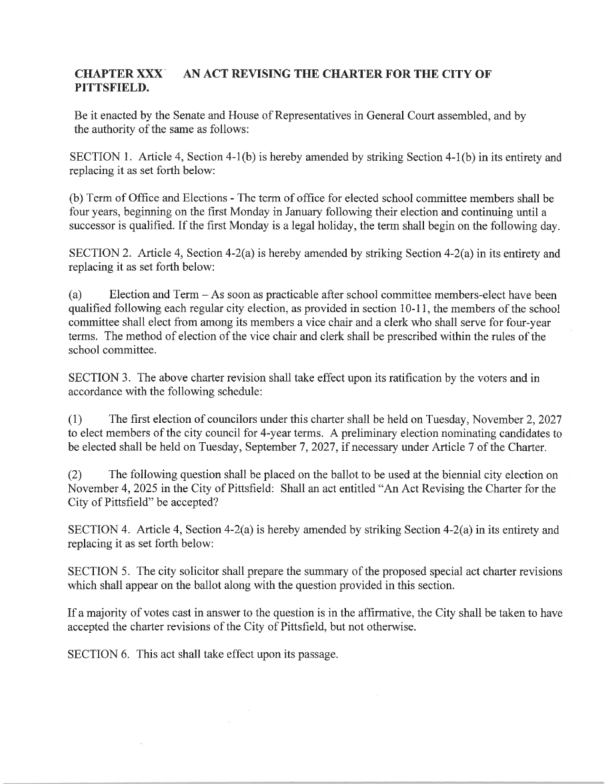
Here is the proposed Special Act for making School Committee member’s terms 4 years:
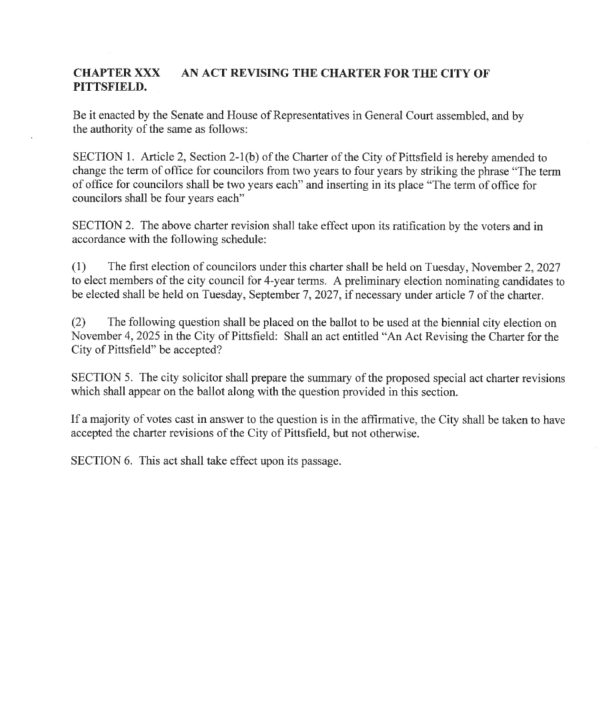
And here is the proposed Special Act for making City Councilor’s terms 4 years:
The process for a Special Act amendment is the City Council votes to approve the charter amendment, then it goes to the State Legislature as a bill to get approved through the normal legislative process where bill has to pass the House and Senate then get signed into law by the Governor.
The amendment doesn’t automatically go to the voters, unless the City Council and/or the State Legislature specifically includes language putting it on a ballot. The City Council did include such language in both petitions.
However, the bill introduced by Rep. Farley-Bouvier to amend the Charter (Bill H.4716) does not contain any provision for the changes to go before the voters. The bill’s language is much simpler than what the voters approved, only requiring the two references in the charter to change the School Committee and City Councils terms from two years to four years. Nothing about it going before the voters. Nothing about when it will come into effect.
SECTION 1. Subsection (b) of section 2-1 of article 2 of the charter of the city of Pittsfield, which is on file in the office of the archivist of the commonwealth pursuant to section 12 of chapter 43B of the General Laws, is hereby amended by striking out the word “two” and inserting in place thereof the following word:- four.
SECTION 2. Subsection (b) of section 4-1 of article 4 of said charter is hereby amended by striking out the word “two” and inserting in place thereof the following word:- four.
This presents a major problem. The Council voted under the assumption that these changes would be going before the voters. I would say most residents and voters in Pittsfield, in favor or opposed to the change, were under the assumption that these changes would be going before the voters as well. Based on my interpretation of the language of the bill, City Councilor and School Committee member terms will be serving 4 year terms starting with the members elected in the 2027 Municipal Election.
And the worse part, the bill has already passed the house. I’ve been tracking this bill for a while now, and I thought the House Committee on Bills in the Third Reading, which catches drafting issues with bills, would catch this error. They did not.
Right now the bill sits in the Massachusetts Senate, and seems to be very close to getting passed and being sent to the Governor for her to sign (which will most likely happen).
So is this Legal?
This is the part where I am unsure, partially because I’m not a lawyer and that I don’t have all of the behind the scenes information about how the bill was drafted.
Section 8. Powers of the General Court. – The general court shall have the power to act in relation to cities and towns, but only by general laws which apply alike to all cities or to all towns, or to all cities and towns, or to a class of not fewer than two, and by special laws enacted (1) on petition filed or approved by the voters of a city or town, or the mayor and city council, or other legislative body, of a city, or the town meeting of a town, with respect to a law relating to that city or town; (2) by a two-thirds vote of each branch of the general court following a recommendation by the governor; (3) to erect and constitute metropolitan or regional entities, embracing any two or more cities or towns or cities and towns, or established with other than existing city or town boundaries, for any general or special public purpose or purposes, and to grant to these entities such powers, privileges and immunities as the general court shall deem necessary or expedient for the regulation and government thereof; or (4) solely for the incorporation or dissolution of cities or towns as corporate entities, alteration of city or town boundaries, and merger or consolidation of cities and towns, or any of these matters.
Based on this, the only way the Legislature can change the City Charter is either through a petition approved by the City Council and Mayor, or by a 2/3rds vote of both branches based on a recommendation from the Governor. As the latter has not happened from my understanding, the change is being enacted based on the Council’s petitions to the State Legislature.
However, the language the Legislature is passing is not in line with what the Council approved, so from my understanding this bill wouldn’t be Constitutional as it is not going through the proper process of amending the City Charter.
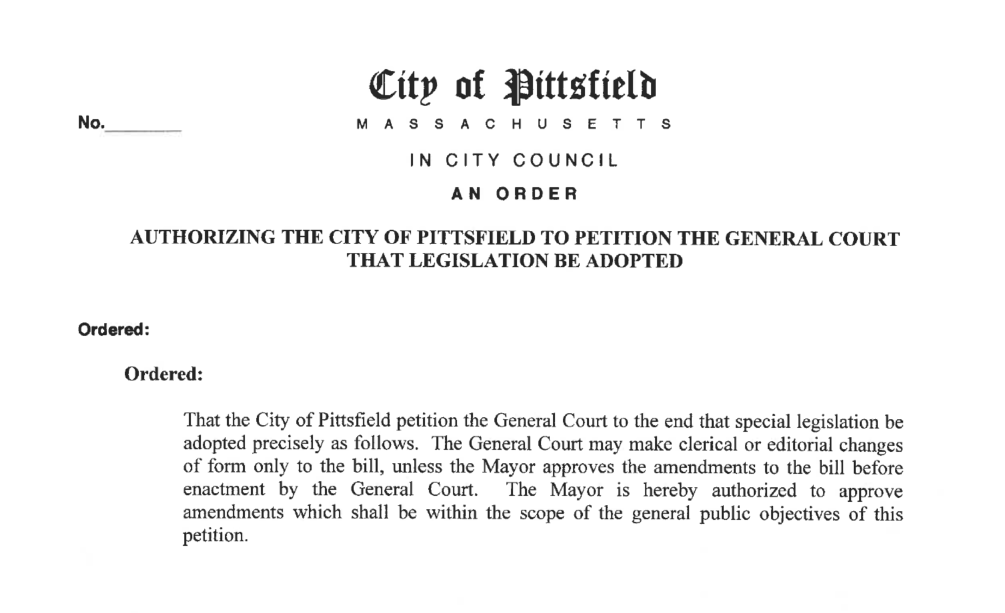
Though there is one caveat, part of the Order the Council passed stated the following:
Based on my reading of the order any amendment to the proposed Special Act to have it not go before the voters would not “be within the scope of the general public objectives of this petition” as one of the primary objectives, in my view, is that the voters would be able to decide if Councilors and School Committee members serve 4 year terms or not.
Additionally, another wrench in all of this is that as the process of getting a Special Act approved is slow, when the Council approved the original two petitions they became out of date as the Council was looking to put both questions on the ballot for the 2025 election, which did not happen. So an amendment would have needed to be made to have the question be put on the 2027 ballot. So I’m not sure if the discussion between the Mayor and the Legislature resulted in the bill being amended so that it wouldn’t go to the voters at all. But I feel that would mean the change was very much out of scope of what the Council originally passed.
So, What Now?
I’m hopeful that this blog post will catch people’s attention to this issue, and hopefully ensure that someone in the Legislature calls attention to the issue and ensures this issue does go before the voters.
If you feel the same way that I do that this should go before the voters, I would highly recommended reaching out to Rep. Farley-Bouvier or Senator Paul Mark, who both represent Pittsfield. There contact information is below.
On the agenda for the May 27th Pittsfield School Committee meeting is the following item: “Discussion and approve a response to an Open Meeting Law violation filed on May 2, 2026, by Ciara Batory against the School Committee for an alleged violation at the Committee’s March 25, 2026, meeting”.
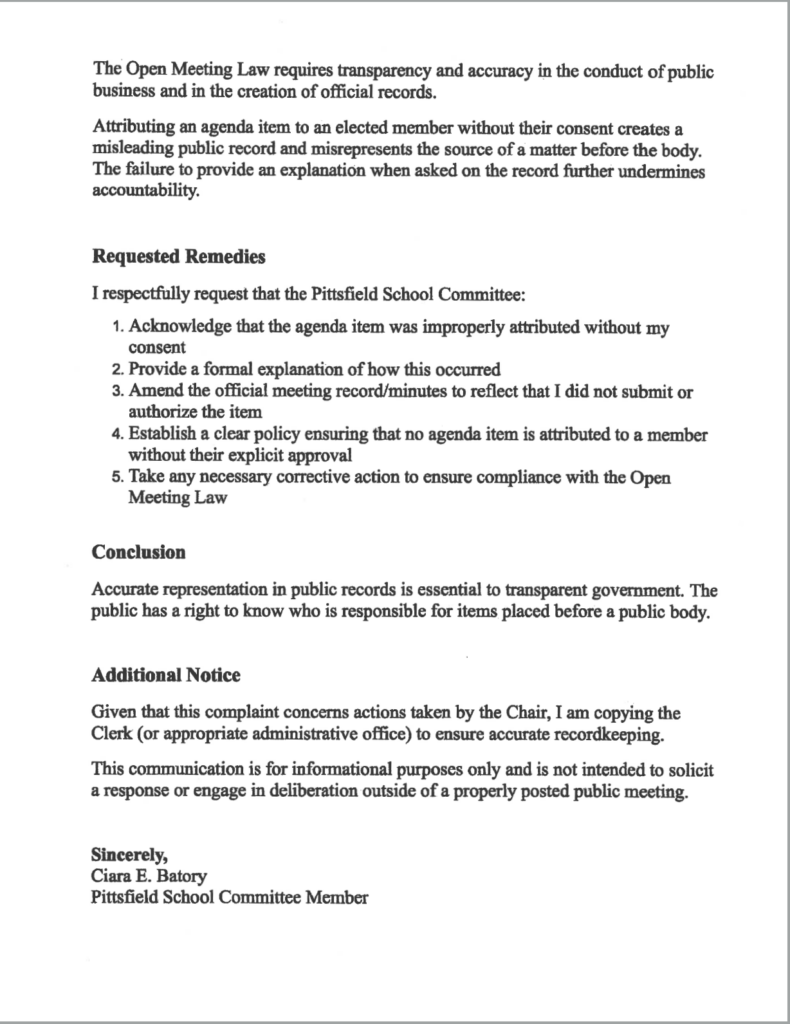
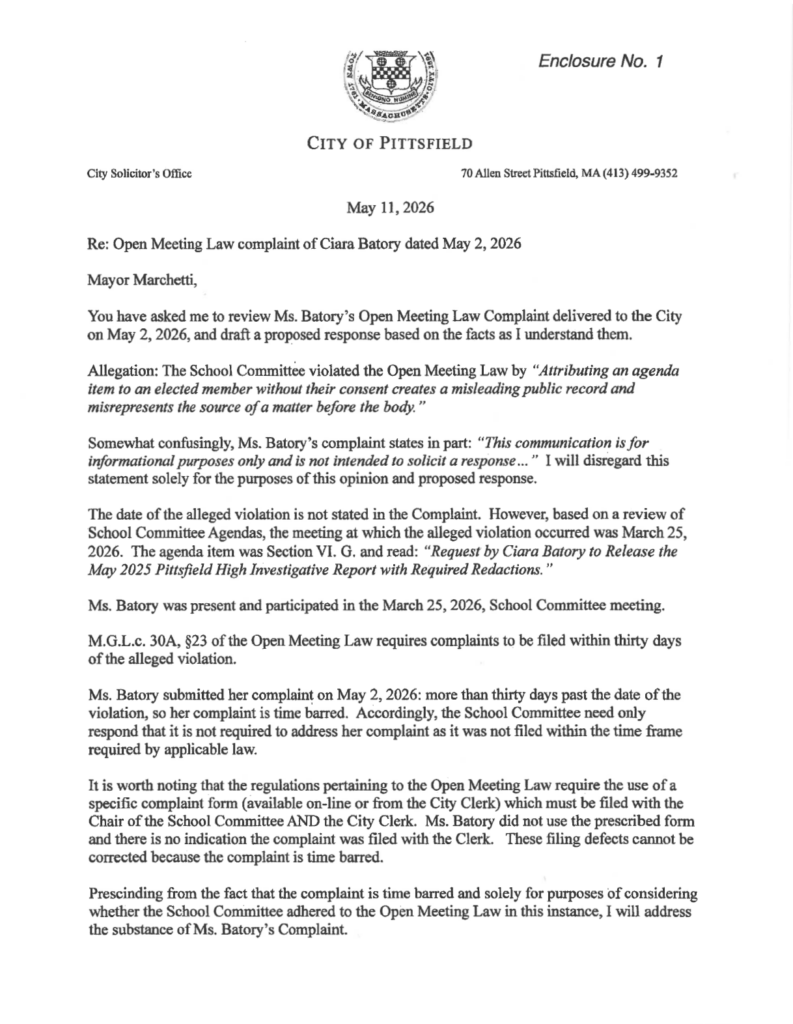
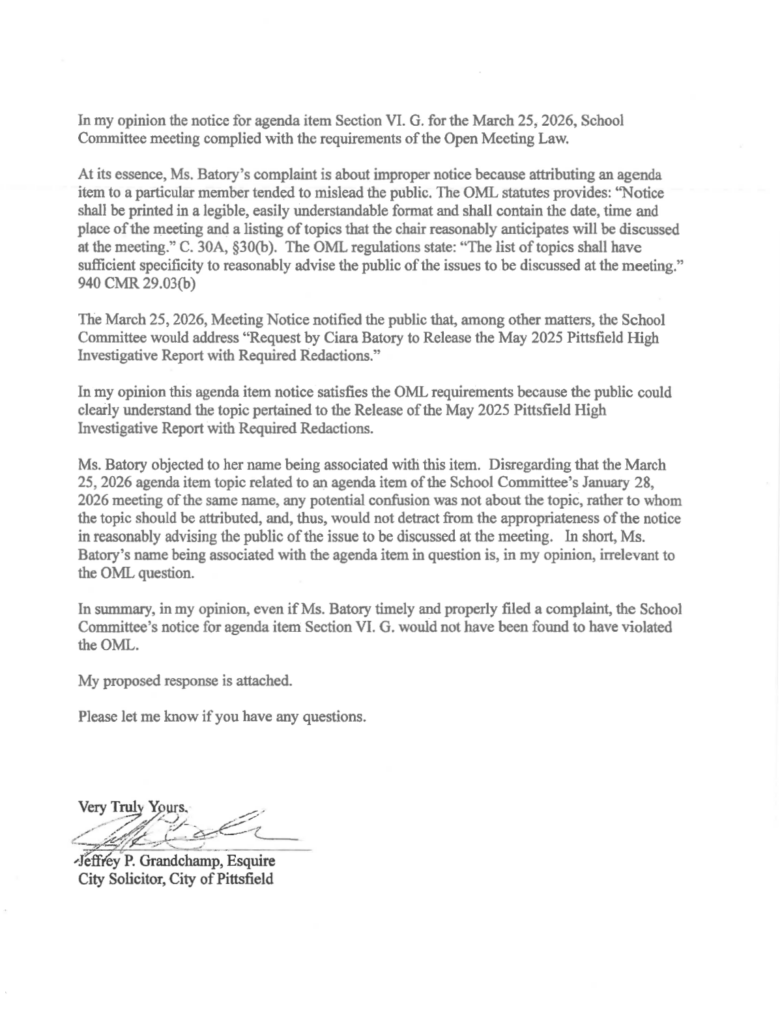
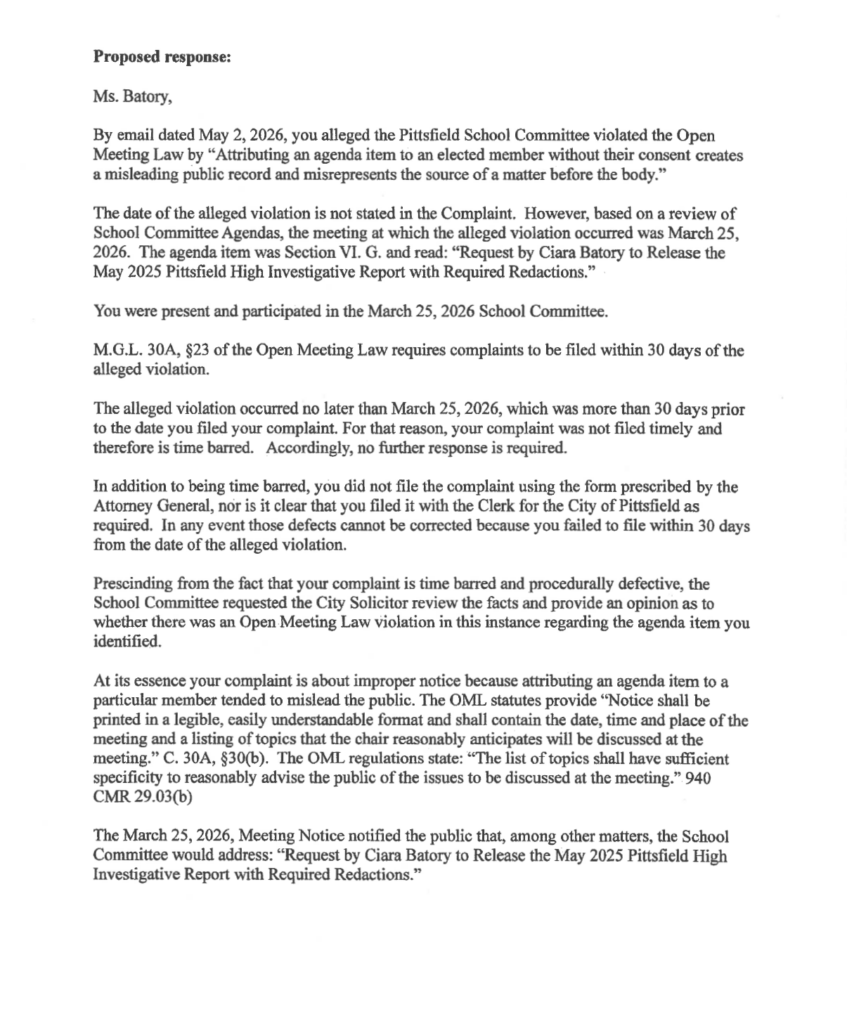
Below is the Open Meeting Law complaint filed by Member Batory as well as the City Solicitor’s response to the complaint, which the Mayor requested to provide a response.
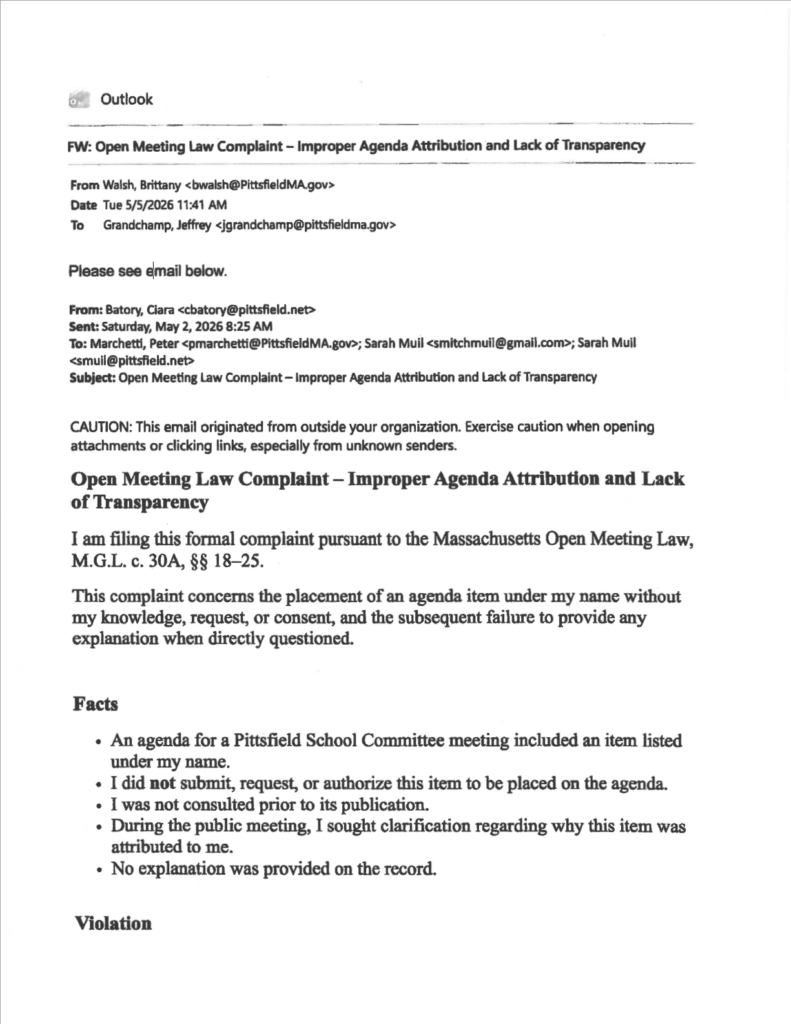
I’m going to attach both screenshots of the complaint, the City Solicitor’s Letter, and the proposed response from the School Committee packet, as well as the text that I got from my PDF reader’s OCR scanner so its more readable in the blog post.
Batory’s Open Meeting Law Complaint
From: Batory, Clara <cbatory@pittsfield.net>
Sent: Saturday, May 2, 2026 8:25 AM
To: Marchetti, Peter <pmarchetti@PittsfieldMA.gov>; Sarah Muil <smitchmuil@gmaii.com>; Sarah Muil <smuil@pittsfield.net>
Subject: Open Meeting Law Complaint — Improper Agenda Attribution and Lack of Transparency
CAUTION: This email originated from outside your organization. Exercise caution when opening
attachments or clicking links, especially from unknown senders.
Open Meeting Law Complaint — Improper Agenda Attribution and Lack of Transparency
I am filing this formal complaint pursuant to the Massachusetts Open Meeting Law, M.G.L. c. 30A, §§ 18-25.
This complaint concerns the placement of an agenda item under my name without my knowledge, request, or consent, and the subsequent failure to provide any explanation when directly questioned.
Facts
• An agenda for a Pittsfield School Committee meeting included an item listed under my name.
• I did not submit, request, or authorize this item to be placed on the agenda.
• I was not consulted prior to its publication.
• During the public meeting, I sought clarification regarding why this item was attributed to me.
• No explanation was provided on the record.
Violation
The Open Meeting Law requires transparency and accuracy in the conduct of public business and in the creation of official records.
Attributing an agenda item to an elected member without their consent creates a misleading public record and misrepresents the source of a matter before the body. The failure to provide an explanation when asked on the record further undermines accountability.
Requested Remedies
I respectfully request that the Pittsfield School Committee:
1. Acknowledge that the agenda item was improperly attributed without my consent
2. Provide a formal explanation of how this occurred
3. Amend the official meeting record/minutes to reflect that I did not submit or authorize the item
4. Establish a clear policy ensuring that no agenda item is attributed to a member without their explicit approval
5. Take any necessary corrective action to ensure compliance with the Open Meeting Law
Conclusion
Accurate representation in public records is essential to transparent government. The public has a right to know who is responsible for items placed before a public body.
Additional Notice
Given that this complaint concerns actions taken by the Chair, I am copying the Clerk (or appropriate administrative office) to ensure accurate recordkeeping.
This communication is for informational purposes only and is not intended to solicit a response or engage in deliberation outside of a properly posted public meeting.
Sincerely,
Ciara E. Batory
Pittsfield School Committee Member
City Solicitors Response
Re: Open Meeting Law complaint of Ciara Batory dated May 2, 2026
Mayor Marchetti,
You have asked me to review Ms. Batory’s Open Meeting Law Complaint delivered to the City on May 2, 2026, and draft a proposed response based on the facts as I understand them.
Allegation: The School Committee violated the Open Meeting Law by “Attributing an agenda item to an elected member without their consent creates a misleading public record and misrepresents the source of a matter before the body”
Somewhat confusingly, Ms. Batory’s complaint states in part: “This communication is for informational purposes only and is not intended to solicit a response… ” I will disregard this statement solely for the purposes of this opinion and proposed response.
The date of the alleged violation is not stated in the Complaint. However, based on a review of School Committee Agendas, the meeting at which the alleged violation occurred was March 25, 2026. The agenda item was Section VI. G. and read: “Request by Ciara Batory to Release the May 2025 Pittsfield High Investigative Report with Required Redactions.”
Ms. Batory was present and participated in the March 25, 2026, School Committee meeting.
M.G.L.c. 30A, §23 of the Open Meeting Law requires complaints to be filed within thirty days of the alleged violation.
Ms. Batory submitted her complaint on May 2, 2026: more than thirty days past the date of the violation, so her complaint is time barred. Accordingly, the School Committee need only respond that it is not required to address her complaint as it was not filed within the time frame required by applicable law.
It is worth noting that the regulations pertaining to the Open Meeting Law require the use of a specific complaint form (available on-line or from the City Clerk) which must be filed with the Chair of the School Committee AND the City Clerk. Ms. Batory did not use the prescribed form and there is no indication the complaint was filed with the Clerk. These filing defects cannot be corrected because the complaint is time barred.
Prescinding from the fact that the complaint is time barred and solely for purposes of considering whether the School Committee adhered to the Open Meeting Law in this instance, I will address the substance of Ms. Batory’s Complaint.
In my opinion the notice for agenda item Section VI. G. for the March 25, 2026, School Committee meeting complied with the requirements of the Open Meeting Law.
At its essence, Ms. Batory’s complaint is about improper notice because attributing an agenda item to a particular member tended to mislead the public. The OML statutes provides: “Notice shall be printed in a legible, easily understandable format and shall contain the date, time and place of the meeting and a listing of topics that the chair reasonably anticipates will be discussed at the meeting.” C. 30A, §30(b). The OML regulations state: “The list of topics shall have sufficient specificity to reasonably advise the public of the issues to be discussed at the meeting.” 940 CMR 29.03(b)
The March 25, 2026, Meeting Notice notified the public that, among other matters, the School Committee would address “Request by Ciara Batory to Release the May 2025 Pittsfield High Investigative Report with Required Redactions.”
In my opinion this agenda item notice satisfies the OML requirements because the public could clearly understand the topic pertained to the Release of the May 2025 Pittsfield High Investigative Report with Required Redactions.
Ms. Batory objected to her name being associated with this item. Disregarding that the March 25, 2026 agenda item topic related to an agenda item of the School Committee’s January 28, 2026 meeting of the same name, any potential confusion was not about the topic, rather to whom the topic should be attributed, and, thus, would not detract from the appropriateness of the notice in reasonably advising the public of the issue to be discussed at the meeting. In short, Ms. Batory’s name being associated with the agenda item in question is, in my opinion, irrelevant to the OML question.
In summary, in my opinion, even if Ms. Batory timely and properly filed a complaint, the School Committee’s notice for agenda item Section VI. G. would not have been found to have violated the OML.
My proposed response is attached.
Please let me know if you have any questions.
Jeffry P. Grandchamp, Esquire
City Solicitor, City of Pittsfield
Proposed Response
Proposed response:
Ms. Batory,
By email dated May 2, 2026, you alleged the Pittsfield School Committee violated the Open
Meeting Law by “Attributing an agenda item to an elected member without their consent creates a misleading public record and misrepresents the source of a matter before the body.”
The date of the alleged violation is not stated in the Complaint. However, based on a review of School Committee Agendas, the meeting at which the alleged violation occurred was March 25, 2026. The agenda item was Section VI. G. and read: “Request by Ciara Batory to Release the May 2025 Pittsfield High Investigative Report with Required Redactions.”
You were present and participated in the March 25, 2026 School Committee.
M.G.L. 30A, §23 of the Open Meeting Law requires complaints to be filed within 30 days of the alleged violation.
The alleged violation occurred no later than March 25, 2026, which was more than 30 days prior to the date you filed your complaint. For that reason, your complaint was not filed timely and therefore is time barred. Accordingly, no further response is required.
In addition to being time barred, you did not file the complaint using the form prescribed by the Attorney General, nor is it clear that you filed it with the Clerk for the City of Pittsfield as required. In any event those defects cannot be corrected because you failed to file within 30 days from the date of the alleged violation.
Prescinding from the fact that your complaint is time barred and procedurally defective, the School Committee requested the City Solicitor review the facts and provide an opinion as to whether there was an Open Meeting Law violation in this instance regarding the agenda item you identified.
At its essence your complaint is about improper notice because attributing an agenda item to a particular member tended to mislead the public. The OML statutes provide “Notice shall be printed in a legible, easily understandable format and shall contain the date, time and place of the meeting and a listing of topics that the chair reasonably anticipates will be discussed at the meeting.” C. 30A, §30(b). The OML regulations state: “The list of topics shall have sufficient specificity to reasonably advise the public of the issues to be discussed at the meeting.”. 940 CMR 29.03(b)
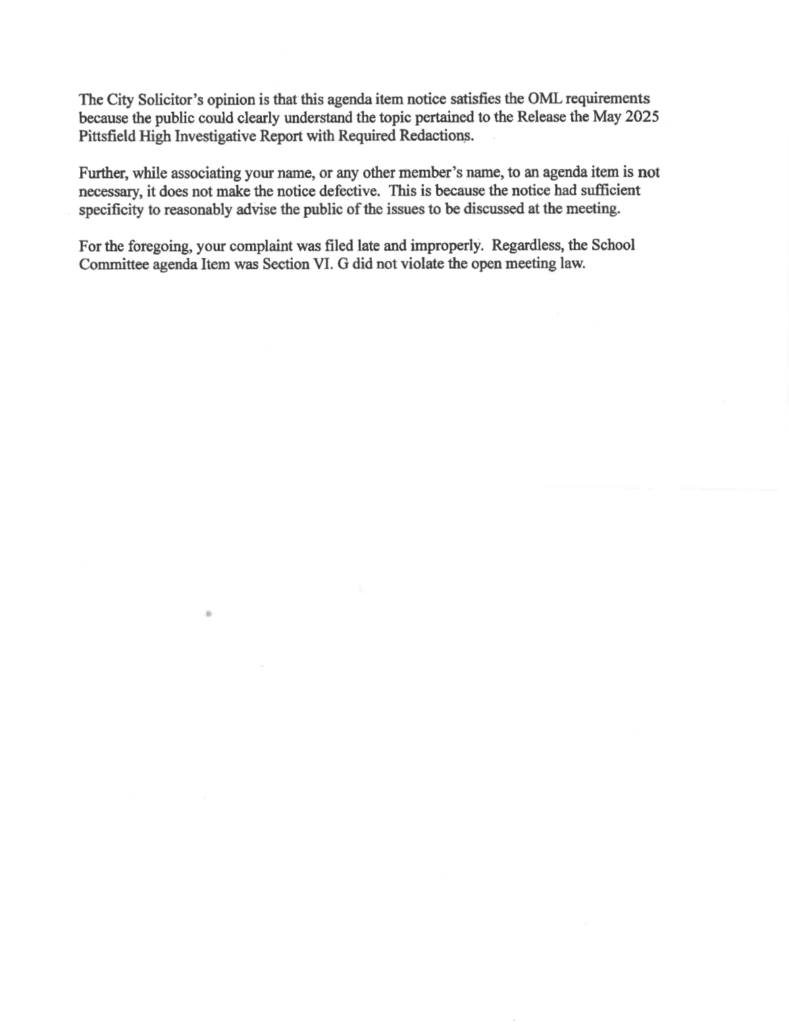
The March 25, 2026, Meeting Notice notified the public that, among other matters, the School Committee would address: “Request by Ciara Batory to Release the May 2025 Pittsfield High Investigative Report with Required Redactions.”The City Solicitor’s opinion is that this agenda item notice satisfies the OML requirements because the public could clearly understand the topic pertained to the Release the May 2025 Pittsfield High Investigative Report with Required Redactions.
Further, while associating your name, or any other member’s name, to an agenda item is not necessary, it does not make the notice defective. This is because the notice had sufficient specificity to reasonably advise the public of the issues to be discussed at the meeting.
For the foregoing, your complaint was filed late and improperly. Regardless, the School Committee agenda Item was Section VI. G did not violate the open meeting law
My Thoughts
I don’t really think there is much to add here as the City Solicitor covered most of the issues of Batory’s Open Meeting Law complaint.
The Open Meeting Law Regulations are clear that any complaint has to be submitted on the proper form (which is easily accessible on the Attorney General’s website) has to be sent to the Committee Chair and the City Clerk, and must be filed within 30 days of the violation occurring. All of which she did not do.
29.05: Complaints (1) All complaints shall be in writing, using the form approved by the Attorney General and available on the Attorney General’s website. A public body need not, and the Attorney General will not, investigate or address anonymous complaints. A public body need not address a complaint that is not signed by the complainant. A public body need not address a complaint that is not filed using the Attorney General’s complaint form.
(2) Public bodies, or the municipal clerk in the case of a local public body, should provide any person, on request, with an Open Meeting Law Complaint Form. If a paper copy is unavailable, then the public body should direct the requesting party to the Attorney General’s website, where an electronic copy of the form will be available for downloading and printing.
(3) For local public bodies, the complainant shall file the complaint with the chair of the public body, who shall disseminate copies of the complaint to the members of the public body. The complainant shall also file a copy of the complaint with the municipal clerk, who shall keep such filings in an orderly fashion for public review on request during regular business hours. For all other public bodies, the complainant shall file the complaint with the chair of the relevant public body, or if there is no chair, then with the public body.
(4) The complaint shall be filed within 30 days of the alleged violation of M.G.L. c. 30A, §§ 18 through 25, or if the alleged violation of M.G.L. c. 30A, §§ 18 through 25, could not reasonably have been known at the time it occurred, then within 30 days of the date it should reasonably have been discovered.
This complaint is pretty much going nowhere. Batory could appeal this to the Attorney General’s office, but they will most certainly dismiss it given she filed it 30 days after the supposed violation occurred. I am sure the discussion at the School Committee meeting will be interesting.
I honestly feel this isn’t an attempt at promoting transparency but to rile people up by claiming that the School Committee is “violating the law”, when there is no real basis for that claim. A better way would be to promote changes to how items appear on the agenda so it is clearer which item belongs to which individual (like the City Council does) which would address unclear agenda items like this one. However, filing an Open Meeting Law complaint (and I’m using “filing” very loosely here) is more flashy and riles people up instead of actually accomplishing anything.
I continue to be very concerned by how Batory promotes herself as being very knowledgeable on topics such as the Open Meeting Law, parliamentary procedure, and school finance, when on a closer examination she makes false statements on these topics. There were very basic procedural things she missed in trying to file this complaint that she could have easily known by searching the Open Meeting Law into Google and looking at the Attorney General’s website.
Sidenote, while I’m not 100% certain her complaint was AI written as I don’t have the original email to go off of instead of a printed then scanned copy of it, in my opinion I feel this complaint is giving off some AI writing vibes to me. The headers and bullet points that are used throughout the email and being vague about what meeting the issue occurred at and what exact part of the law was violated feels AI-like to me. The language in the “additional notice” section also seems weird, such as the phrase “copying the Clerk (or appropriate administrative office) to ensure accurate recordkeeping” which doesn’t explicitly say who the complaint is being sent to. As mentioned by the City Solicitor, the phrase “this communication is for informational purposes only and is not intended to solicit a response or engage in deliberation outside of a properly posted public meeting” does contradict how a complaint should be handled. This would track with her past uses of AI which were more discernible, though this is just how I feel.
It’s fine to say that you don’t know or are unsure about something as an elected official when trying to explain things. But when you say “I know this” which such confidence, and then are wrong about it, it becomes a problem. People become misled and small problems and mistakes become bigger issues that distract from the real issues facing the Pittsfield Public Schools such as the budget, the transition that will need to take place with closing Morningside, and addressing racism and homophobia in our schools and in our community.
I’ll end with this, people have reached out to me asking what is the best way to share their voice about their similar concerns regarding the dysfunction of the current School Committee. The best way to do that is at the public comment portion of the Committee meetings. This not only provides the opportunity to address the Committee directly, but also shows the press and the public watching that people are seeing through these false claims and want a functional School Committee again that is addressing the issues that actually affect for our students.
If you feel the same way I do, I encourage you to speak at the next School Committee meeting on Wednesday, May 27th at 6pm in City Hall Council Chambers. Make sure to get there early so you can sign up to speak.
Note that the thoughts expressed in this blog are my own and are not representative of the Massachusetts Association of Student Representatives, the Massachusetts Association of School Committees, or any other group.
More interestingly is that some media outlets out towards Boston, namely WGBH who wrote a whole article about it, have written about this proposal and some of the reactions to it by various groups and officials. Absent from these articles is the bill that is currently in the statehouse to do this very same thing for all school committees in Massachusetts, not just Boston.
But in the WGBH article, some concerns were raised regarding giving student representatives the right to vote on their respective school committees, which I feel would be beneficial to discuss.
Response to Concerns
Giving Student Representatives Would Result in a Domino Effect Resulting in Other Stakeholders Asking for Voting Rights on School Committees
The first concern raised is that giving student representatives the right to vote would result in opening up “a can of worms” due to their stakeholder status, and that there is now potential for the “union president” and the “special education PAC” to ask for the right to vote. While this is a valid concern, I don’t really see this being too much of an issue.
Teachers unions already have a more powerful seat at the table then students do regarding school committee matters. Sure they don’t comment on anything unless they are aggravated by an action by the school committee or are dissatisfied by how bargaining is proceeding, but they still have a lot more power than students do currently. A school committee can ignore their student representatives or even their student body, but they can’t ignore the teachers union (unless they really want to get into trouble). If a teachers union is not happy about something the school committee is doing, the committee will be sure to hear about it and most likely be pressured into addressing whatever the union has raised. This is especially the case in this political (for a lack of a better term) climate where teachers unions are now holding illegal strikes. And also lets not forget that teachers unions have one thing that students don’t have, which is the power to collective bargain with the school committee regarding wages and working/learning conditions. It would also be a big stretch for a teachers union to advocate for a teacher to have a vote on the school committee, as that would be giving them even more power than they already have and create a lot of issues around voting on their collective bargaining agreements. I think it is safe to say that unions won’t be asking for voting rights on school committees.
For other groups such as the “special education PAC”, I still don’t believe this will be an issue because the members of special education PACs, as well as other district related groups (which tend to mostly be made up of parents), are made up of members who can vote and run for school committee. Nothing is stopping any parent or any parent member of these groups from running for a seat on their local school committee. Most students on the other hand can’t due to their age, so they have no other way to gain a voting seat at the table.
Student’s Ability to Think Critically and Understand their Responsibilities
The second concern raised has to do with student’s ability to be “fully and responsibly aware of their obligations to think critically and fairly”. Though a reasonable concern given that students brains are still developing, in my time as a student representative networking with other student representatives and other student leaders I feel confident saying that students do understand their obligations to think critically and fairly, as well as their general responsibilities in their roles.
I think my term as a student representative speaks volumes on how there are students out there that can understand their responsibilities and obligations in their role. But there are other examples as well. Take a look at former Billerica student representative Sean Simonini’s work on his school committee and founding the Massachusetts Association of Student Representatives. Take a look at former Worcester student representative Stacia Zoghbi’s work on her school committee and her front page article on the Boston Globe. Or even more recently the work student representative to the Board of Elementary and Secondary Education Eric Plankey put in when deliberating and voting on the charter school proposal in Worcester by actually reaching out to students in Worcester currently to hear their thoughts on the proposal. Its safe to say that there are students out there that do understand their roles and their responsibilities, as well as to think critically.
Heck I would even say that most students have more ability to think critically and fairly about decisions, as well as understand their responsibility of their roles and take them more seriously than some currentlocalofficials and even some of our currentfederalrepresentatives.
Now there are some legitimate concerns regarding students ability to think critically and fairly about decisions before them. For instance, student representatives could be influenced by their parents when deciding on how to vote on a certain matter, rather than the student body they represent. But I don’t see this happening much, especially since that high schoolers (who will be the only student eligible to be student representatives on school committees) have a greater ability to think critically without influence than students in middle and elementary school.
Though I think the bigger concern is with student representatives being influenced to vote in favor of what the school administration or their student government advisor is in favor of due to the inherent power imbalance between school staff (both administrators and advisors) and students. Unfortunately this is a widespread problem in regards to student governance, and if student representatives get voting rights this could become more of an issue with voting rights now at stake. But I am hopeful that this could also not be the case and the weight of the law will prevent school administration and advisors from influencing student representatives to vote in a certain way (or weather some really bad publicity if it became public as was seen in Boston some time ago).
But I think the biggest concern will be getting student representatives who are willing to be dedicated to their role and the responsibilities that come to it. This is especially a concern as student representatives would be elected not appointed (as they should), and school elections can tend to devolve into “popularity contests” with the most “popular” person winning the election but isn’t dedicated to their role. This concern came up last year with the Massachusetts Association of Student Representatives, and I worked on template election procedures that were rigorous enough so that only students dedicated to their roles would end up on the ballot. I implemented these procedures at Taconic and they were also implemented at PHS, and it resulted in 5 student representatives who regularly show up at meetings and participate in school committee deliberations, which I think shows how successful the procedures worked. I believe if school committees and school districts put this amount of effort into designing and implementing their student representative election procedures, they will most likely get student representatives who are dedicated to their role and understand their responsibilities.
Conclusion
Student representative voting rights will continue to become a hot topic issue and more concerns will be raised about the proposal. And hopefully within the next couple of months the bill that is currently in the statehouse to require all school committees to have voting student representatives will gain more traction in the media. I would hate to see this become a Boston only proposal, while it should be a statewide proposal. It’s only fair to students that all school committees get student representative voting rights, not just Boston.
This past week a bill was filed in the Massachusetts House and Senate to give student representatives voting rights on their local school committees. The Senate bill was filed by Senator Adam Gomez (SD759) and the House bill was filed by Rep. Tricia Farley-Bouvier (HD2806) with help of the Massachusetts Association of Student Representatives (MASR), which I was a founding group member of. Lets take a look at the bill!