I haven’t posted as much over the past couple of months, primary been busy with entering the “adult world” after graduating college and settling into my new job and new routines. However, I am trying to get back into the swing of making new posts.
I want to start with a quick life update, back at the beginning of August I officially moved to Dalton. I found a really nice apartment that was within my budget, and so I decided to jump on it and move in.
It was bittersweet moving out of my family home where I lived for the past 22 years of my life, and I will miss it. Living on my own will definitely not be the same.
I will say it was was a tough decision to leave Pittsfield, where I lived all my life and where I’ve been very involved politically over the past few years. I always thought I would stay in Pittsfield for several years after I graduated. However the rental market looked much better outside of Pittsfield in places such as Dalton from a price and safety perspective.
Additionally, the more I thought about it running for local office in Pittsfield didn’t fit into my life plans at the moment. I don’t feel ready to dive back in, run a campaign, and all that is involved in running for and serving in elected office. It’s a lot to take on and I’m just not ready to do it all again.
Though I’m still planning keep an eye on Pittsfield politics here and there too, given that I’m just over the city line and still have a lot of insight on the inner workings of Pittsfield politics, along with a lot of strong feelings about the direction the City is going in. I have some blog post ideas to discuss my thoughts about Pittsfield politics, as well as some other blog posts ideas about other local and state political issues. I’m hoping to get those posts out over the next few weeks or so. Stay tuned!
The Massachusetts State Primary election is coming up tomorrow (or today depending on when you are reading this), and unfortunately there isn’t a whole lot of exciting races on the ballot this year, mainly on the Democratic ballot. I was disappointed to see the Democratic Governors race be uncontested as I feel we could use some real contest there, and there are a lot of uncontested races at the local level for State Representative and State Senator.
However, for Berkshire County there are three races (four if you are in the 1st Berkshire House District) that are contested on the Democratic ballot. Here is who I will be voting for in those races:
Senator in Congress: Edward Markey
This one felt like a no brainer to me. Senator Markey has done a lot of good stuff for Massachusetts, including Berkshire County. He’s very progressive, and in this time and age the Democratic Party needs to be pushing for more bold visions and ideas to combat what we are currently seeing and doing at the national level, bland centristism is not going to get us anywhere.
This one was the tricker one for me and I was still undecided even a few days ago. Really the reason why I’m voting with Whalen comes down to this: I’ve been disappointed in the Democratic party, especially in Congress, when it comes to opposing the Trump administration. They aren’t fighting back enough, we need more pushback and willingness to bend the rules like the Republicans are doing right now.
While I like a lot of the things Representative Neal has done for the area, in particular for MCLA, BCC, and the City of Pittsfield, I think it is a time for a change. The only way to change the Democratic party is to elect new Democrats, and I think Whalen brings a lot to the table in that regard.
He is a former teacher, so he is education orientated. He is progressive and brings progressive values forward, like Markey. And he will bring a fresh perspective to the table willing to fight for Western Massachusetts. Plus he supports Medicare for All, which after dabbing my toes into our broken healthcare system is much needed because our current system is way too broken and unfair.
I don’t think Representative Neal is necessary a bad person, but change is not going to happen if you keep electing the same people over and over again to office. If we want to win back all three chambers of government in 2028, we will need new ideas and new voices.
Councilor: Tara Jacobs
This one is also a no brainer. Living in Berkshire County, Jacobs helps to represent Berkshire County and the other counties of her district on the Governor’s Council. She has kept her constituents informed on what is going on the Council by holding constituent meetings and hearings in her district. And she has helped to bring much more awareness to this public body in Berkshire County than her predecessors ever had.
Her opponent, Michael Fenton, lives in Springfield and claims to want to help represent Berkshire County more, but I doubt it. Why would someone from Springfield be able to represent Berkshire County more than someone who actually lives in Berkshire County? This is why I feel the DA’s and Sherriff’s critiques of Jacobs rings hollow, because we would be giving up a major seat at the table to someone who is most likely just going to represent the Springfield area the whole time. Their critiques is actually more of a reason to vote for Jacobs, as she does her research and doesn’t just go with what the Governor or the DA wants for judges or on the parole board, she goes with who will serve Massachusetts residents the best.
(Bonus) 1st Berkshire House District: Andrew Fitch
Unfortunately, I don’t live in the 1st Berkshire district, if I did I would be voting for Andrew Fitch.
A lot of it is the same reasons why I am voting for Whalen over Neal, more progressive and more younger. I think Fitch would bring a fresher perspective for the Northern Berkshire area to the State House over John Barrett, who has been in North Adams politics for decades. Additionally, being as a former MCLA student, I feel having someone with a fresh voice representing the district the college resides in would greatly benefit the college and its students in getting more state funding and support.
Moving away from School Committee coverage for now, I want to focus on something that has not been on most people’s minds since fall of last year: the amendments to the City of Pittsfield’s Charter that the City Council proposed and passed, primarily regarding moving to 4 year terms for School Committee members and City Councilors.
Back in August, the City Council voted to petition the State Legislature with two Special Act amendments to the City Charter to increase the terms of City Councilors and School Committee members from 2 years to 4 years, in line with the Mayor. This was billed as a way to make local government more stable as well as to save money by not having to run a local elections as often.
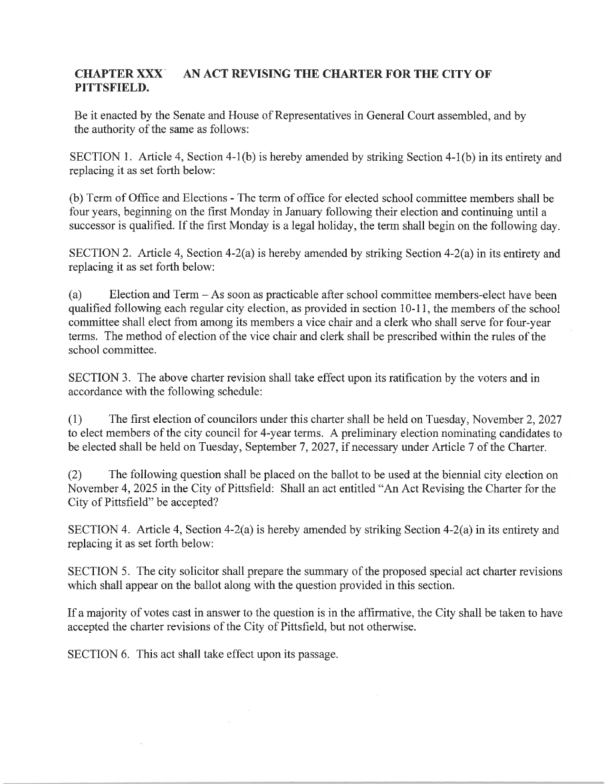
Here is the proposed Special Act for making School Committee member’s terms 4 years:
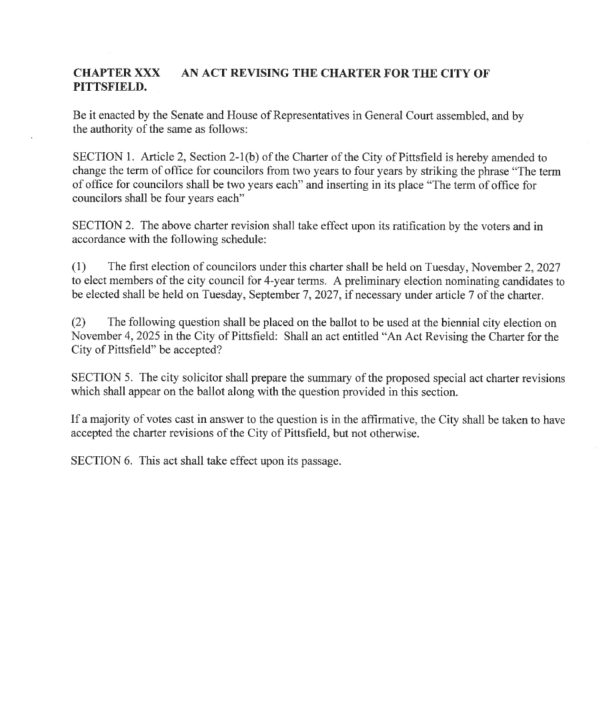
And here is the proposed Special Act for making City Councilor’s terms 4 years:
The process for a Special Act amendment is the City Council votes to approve the charter amendment, then it goes to the State Legislature as a bill to get approved through the normal legislative process where bill has to pass the House and Senate then get signed into law by the Governor.
The amendment doesn’t automatically go to the voters, unless the City Council and/or the State Legislature specifically includes language putting it on a ballot. The City Council did include such language in both petitions.
However, the bill introduced by Rep. Farley-Bouvier to amend the Charter (Bill H.4716) does not contain any provision for the changes to go before the voters. The bill’s language is much simpler than what the voters approved, only requiring the two references in the charter to change the School Committee and City Councils terms from two years to four years. Nothing about it going before the voters. Nothing about when it will come into effect.
SECTION 1. Subsection (b) of section 2-1 of article 2 of the charter of the city of Pittsfield, which is on file in the office of the archivist of the commonwealth pursuant to section 12 of chapter 43B of the General Laws, is hereby amended by striking out the word “two” and inserting in place thereof the following word:- four.
SECTION 2. Subsection (b) of section 4-1 of article 4 of said charter is hereby amended by striking out the word “two” and inserting in place thereof the following word:- four.
This presents a major problem. The Council voted under the assumption that these changes would be going before the voters. I would say most residents and voters in Pittsfield, in favor or opposed to the change, were under the assumption that these changes would be going before the voters as well. Based on my interpretation of the language of the bill, City Councilor and School Committee member terms will be serving 4 year terms starting with the members elected in the 2027 Municipal Election.
And the worse part, the bill has already passed the house. I’ve been tracking this bill for a while now, and I thought the House Committee on Bills in the Third Reading, which catches drafting issues with bills, would catch this error. They did not.
Right now the bill sits in the Massachusetts Senate, and seems to be very close to getting passed and being sent to the Governor for her to sign (which will most likely happen).
So is this Legal?
This is the part where I am unsure, partially because I’m not a lawyer and that I don’t have all of the behind the scenes information about how the bill was drafted.
Section 8. Powers of the General Court. – The general court shall have the power to act in relation to cities and towns, but only by general laws which apply alike to all cities or to all towns, or to all cities and towns, or to a class of not fewer than two, and by special laws enacted (1) on petition filed or approved by the voters of a city or town, or the mayor and city council, or other legislative body, of a city, or the town meeting of a town, with respect to a law relating to that city or town; (2) by a two-thirds vote of each branch of the general court following a recommendation by the governor; (3) to erect and constitute metropolitan or regional entities, embracing any two or more cities or towns or cities and towns, or established with other than existing city or town boundaries, for any general or special public purpose or purposes, and to grant to these entities such powers, privileges and immunities as the general court shall deem necessary or expedient for the regulation and government thereof; or (4) solely for the incorporation or dissolution of cities or towns as corporate entities, alteration of city or town boundaries, and merger or consolidation of cities and towns, or any of these matters.
Based on this, the only way the Legislature can change the City Charter is either through a petition approved by the City Council and Mayor, or by a 2/3rds vote of both branches based on a recommendation from the Governor. As the latter has not happened from my understanding, the change is being enacted based on the Council’s petitions to the State Legislature.
However, the language the Legislature is passing is not in line with what the Council approved, so from my understanding this bill wouldn’t be Constitutional as it is not going through the proper process of amending the City Charter.
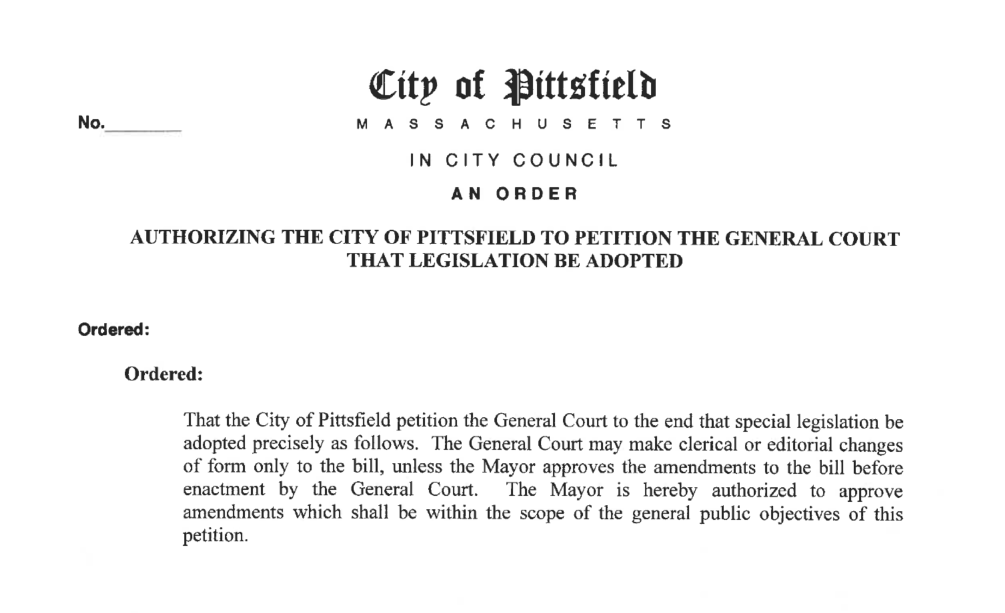
Though there is one caveat, part of the Order the Council passed stated the following:
Based on my reading of the order any amendment to the proposed Special Act to have it not go before the voters would not “be within the scope of the general public objectives of this petition” as one of the primary objectives, in my view, is that the voters would be able to decide if Councilors and School Committee members serve 4 year terms or not.
Additionally, another wrench in all of this is that as the process of getting a Special Act approved is slow, when the Council approved the original two petitions they became out of date as the Council was looking to put both questions on the ballot for the 2025 election, which did not happen. So an amendment would have needed to be made to have the question be put on the 2027 ballot. So I’m not sure if the discussion between the Mayor and the Legislature resulted in the bill being amended so that it wouldn’t go to the voters at all. But I feel that would mean the change was very much out of scope of what the Council originally passed.
So, What Now?
I’m hopeful that this blog post will catch people’s attention to this issue, and hopefully ensure that someone in the Legislature calls attention to the issue and ensures this issue does go before the voters.
If you feel the same way that I do that this should go before the voters, I would highly recommended reaching out to Rep. Farley-Bouvier or Senator Paul Mark, who both represent Pittsfield. There contact information is below.
On the agenda for the May 27th Pittsfield School Committee meeting is the following item: “Discussion and approve a response to an Open Meeting Law violation filed on May 2, 2026, by Ciara Batory against the School Committee for an alleged violation at the Committee’s March 25, 2026, meeting”.
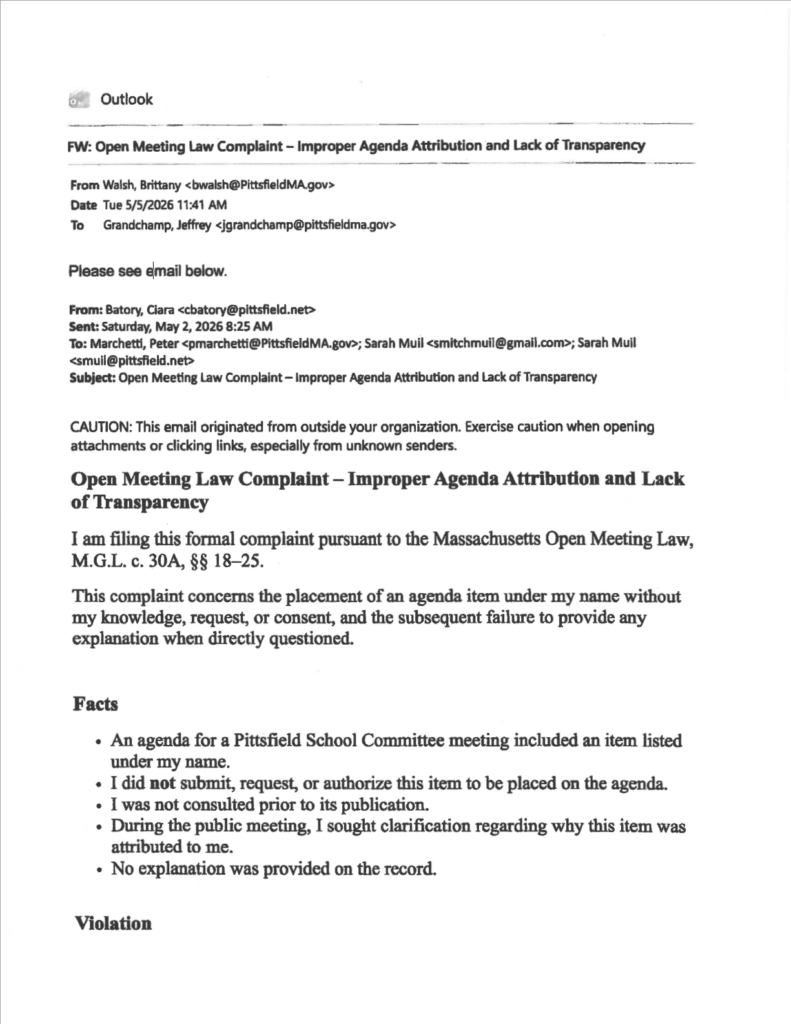
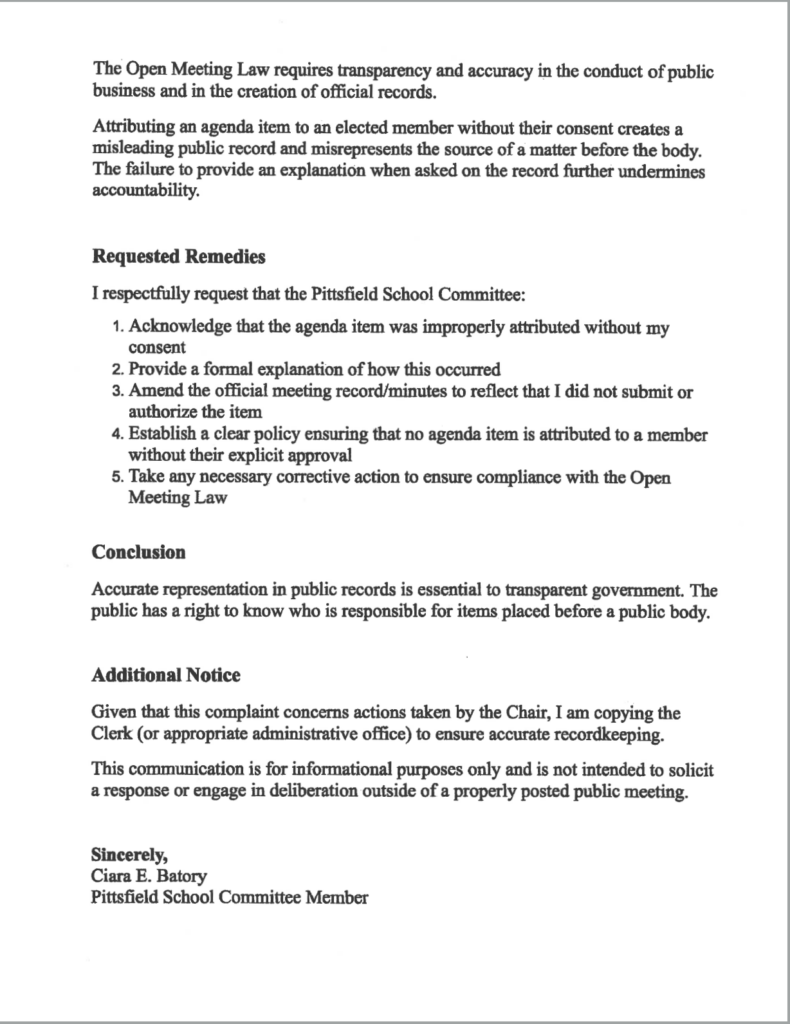
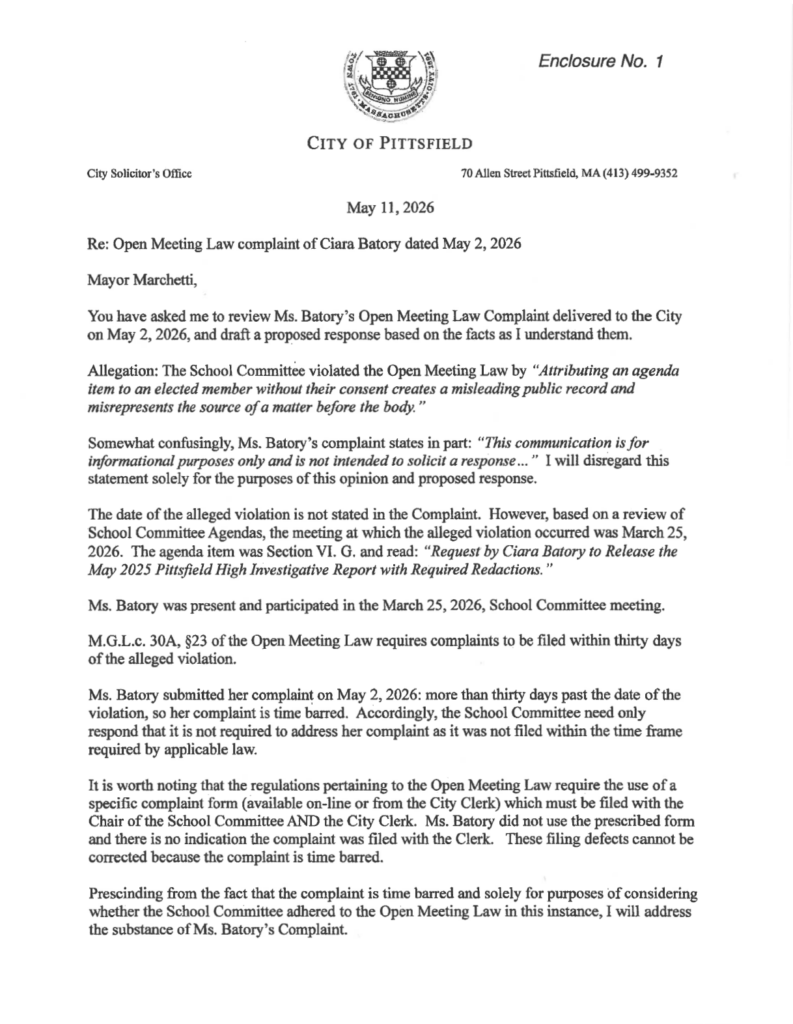
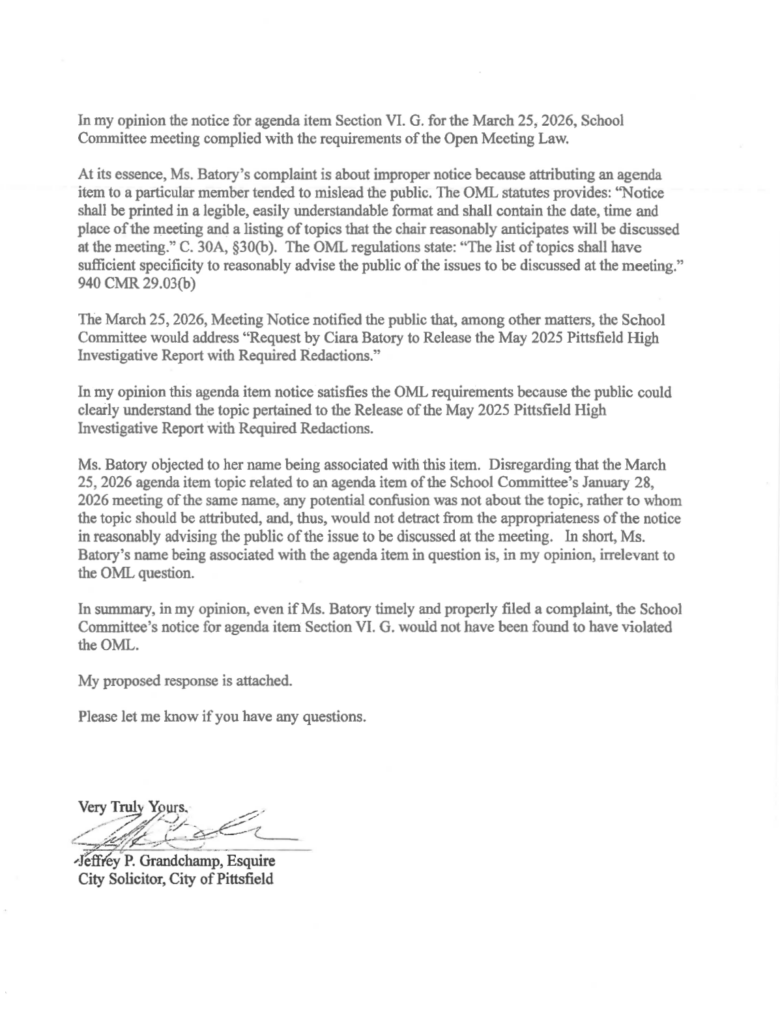
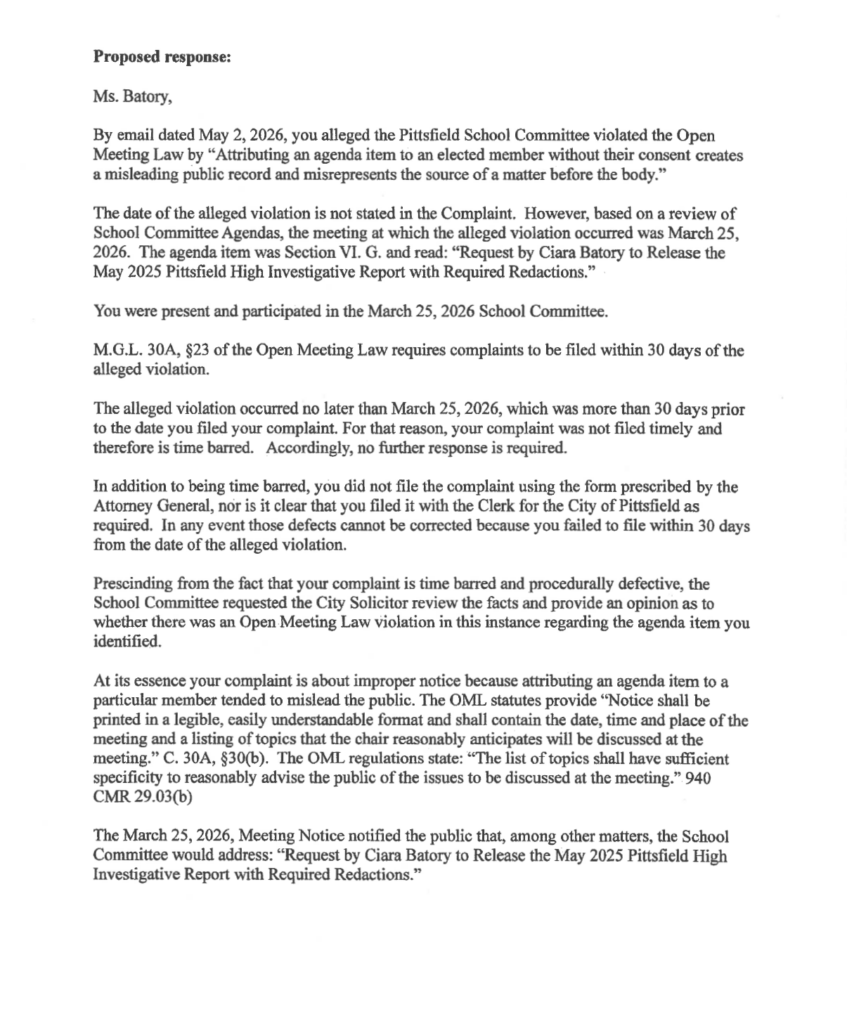
Below is the Open Meeting Law complaint filed by Member Batory as well as the City Solicitor’s response to the complaint, which the Mayor requested to provide a response.
I’m going to attach both screenshots of the complaint, the City Solicitor’s Letter, and the proposed response from the School Committee packet, as well as the text that I got from my PDF reader’s OCR scanner so its more readable in the blog post.
Batory’s Open Meeting Law Complaint
From: Batory, Clara <cbatory@pittsfield.net>
Sent: Saturday, May 2, 2026 8:25 AM
To: Marchetti, Peter <pmarchetti@PittsfieldMA.gov>; Sarah Muil <smitchmuil@gmaii.com>; Sarah Muil <smuil@pittsfield.net>
Subject: Open Meeting Law Complaint — Improper Agenda Attribution and Lack of Transparency
CAUTION: This email originated from outside your organization. Exercise caution when opening
attachments or clicking links, especially from unknown senders.
Open Meeting Law Complaint — Improper Agenda Attribution and Lack of Transparency
I am filing this formal complaint pursuant to the Massachusetts Open Meeting Law, M.G.L. c. 30A, §§ 18-25.
This complaint concerns the placement of an agenda item under my name without my knowledge, request, or consent, and the subsequent failure to provide any explanation when directly questioned.
Facts
• An agenda for a Pittsfield School Committee meeting included an item listed under my name.
• I did not submit, request, or authorize this item to be placed on the agenda.
• I was not consulted prior to its publication.
• During the public meeting, I sought clarification regarding why this item was attributed to me.
• No explanation was provided on the record.
Violation
The Open Meeting Law requires transparency and accuracy in the conduct of public business and in the creation of official records.
Attributing an agenda item to an elected member without their consent creates a misleading public record and misrepresents the source of a matter before the body. The failure to provide an explanation when asked on the record further undermines accountability.
Requested Remedies
I respectfully request that the Pittsfield School Committee:
1. Acknowledge that the agenda item was improperly attributed without my consent
2. Provide a formal explanation of how this occurred
3. Amend the official meeting record/minutes to reflect that I did not submit or authorize the item
4. Establish a clear policy ensuring that no agenda item is attributed to a member without their explicit approval
5. Take any necessary corrective action to ensure compliance with the Open Meeting Law
Conclusion
Accurate representation in public records is essential to transparent government. The public has a right to know who is responsible for items placed before a public body.
Additional Notice
Given that this complaint concerns actions taken by the Chair, I am copying the Clerk (or appropriate administrative office) to ensure accurate recordkeeping.
This communication is for informational purposes only and is not intended to solicit a response or engage in deliberation outside of a properly posted public meeting.
Sincerely,
Ciara E. Batory
Pittsfield School Committee Member
City Solicitors Response
Re: Open Meeting Law complaint of Ciara Batory dated May 2, 2026
Mayor Marchetti,
You have asked me to review Ms. Batory’s Open Meeting Law Complaint delivered to the City on May 2, 2026, and draft a proposed response based on the facts as I understand them.
Allegation: The School Committee violated the Open Meeting Law by “Attributing an agenda item to an elected member without their consent creates a misleading public record and misrepresents the source of a matter before the body”
Somewhat confusingly, Ms. Batory’s complaint states in part: “This communication is for informational purposes only and is not intended to solicit a response… ” I will disregard this statement solely for the purposes of this opinion and proposed response.
The date of the alleged violation is not stated in the Complaint. However, based on a review of School Committee Agendas, the meeting at which the alleged violation occurred was March 25, 2026. The agenda item was Section VI. G. and read: “Request by Ciara Batory to Release the May 2025 Pittsfield High Investigative Report with Required Redactions.”
Ms. Batory was present and participated in the March 25, 2026, School Committee meeting.
M.G.L.c. 30A, §23 of the Open Meeting Law requires complaints to be filed within thirty days of the alleged violation.
Ms. Batory submitted her complaint on May 2, 2026: more than thirty days past the date of the violation, so her complaint is time barred. Accordingly, the School Committee need only respond that it is not required to address her complaint as it was not filed within the time frame required by applicable law.
It is worth noting that the regulations pertaining to the Open Meeting Law require the use of a specific complaint form (available on-line or from the City Clerk) which must be filed with the Chair of the School Committee AND the City Clerk. Ms. Batory did not use the prescribed form and there is no indication the complaint was filed with the Clerk. These filing defects cannot be corrected because the complaint is time barred.
Prescinding from the fact that the complaint is time barred and solely for purposes of considering whether the School Committee adhered to the Open Meeting Law in this instance, I will address the substance of Ms. Batory’s Complaint.
In my opinion the notice for agenda item Section VI. G. for the March 25, 2026, School Committee meeting complied with the requirements of the Open Meeting Law.
At its essence, Ms. Batory’s complaint is about improper notice because attributing an agenda item to a particular member tended to mislead the public. The OML statutes provides: “Notice shall be printed in a legible, easily understandable format and shall contain the date, time and place of the meeting and a listing of topics that the chair reasonably anticipates will be discussed at the meeting.” C. 30A, §30(b). The OML regulations state: “The list of topics shall have sufficient specificity to reasonably advise the public of the issues to be discussed at the meeting.” 940 CMR 29.03(b)
The March 25, 2026, Meeting Notice notified the public that, among other matters, the School Committee would address “Request by Ciara Batory to Release the May 2025 Pittsfield High Investigative Report with Required Redactions.”
In my opinion this agenda item notice satisfies the OML requirements because the public could clearly understand the topic pertained to the Release of the May 2025 Pittsfield High Investigative Report with Required Redactions.
Ms. Batory objected to her name being associated with this item. Disregarding that the March 25, 2026 agenda item topic related to an agenda item of the School Committee’s January 28, 2026 meeting of the same name, any potential confusion was not about the topic, rather to whom the topic should be attributed, and, thus, would not detract from the appropriateness of the notice in reasonably advising the public of the issue to be discussed at the meeting. In short, Ms. Batory’s name being associated with the agenda item in question is, in my opinion, irrelevant to the OML question.
In summary, in my opinion, even if Ms. Batory timely and properly filed a complaint, the School Committee’s notice for agenda item Section VI. G. would not have been found to have violated the OML.
My proposed response is attached.
Please let me know if you have any questions.
Jeffry P. Grandchamp, Esquire
City Solicitor, City of Pittsfield
Proposed Response
Proposed response:
Ms. Batory,
By email dated May 2, 2026, you alleged the Pittsfield School Committee violated the Open
Meeting Law by “Attributing an agenda item to an elected member without their consent creates a misleading public record and misrepresents the source of a matter before the body.”
The date of the alleged violation is not stated in the Complaint. However, based on a review of School Committee Agendas, the meeting at which the alleged violation occurred was March 25, 2026. The agenda item was Section VI. G. and read: “Request by Ciara Batory to Release the May 2025 Pittsfield High Investigative Report with Required Redactions.”
You were present and participated in the March 25, 2026 School Committee.
M.G.L. 30A, §23 of the Open Meeting Law requires complaints to be filed within 30 days of the alleged violation.
The alleged violation occurred no later than March 25, 2026, which was more than 30 days prior to the date you filed your complaint. For that reason, your complaint was not filed timely and therefore is time barred. Accordingly, no further response is required.
In addition to being time barred, you did not file the complaint using the form prescribed by the Attorney General, nor is it clear that you filed it with the Clerk for the City of Pittsfield as required. In any event those defects cannot be corrected because you failed to file within 30 days from the date of the alleged violation.
Prescinding from the fact that your complaint is time barred and procedurally defective, the School Committee requested the City Solicitor review the facts and provide an opinion as to whether there was an Open Meeting Law violation in this instance regarding the agenda item you identified.
At its essence your complaint is about improper notice because attributing an agenda item to a particular member tended to mislead the public. The OML statutes provide “Notice shall be printed in a legible, easily understandable format and shall contain the date, time and place of the meeting and a listing of topics that the chair reasonably anticipates will be discussed at the meeting.” C. 30A, §30(b). The OML regulations state: “The list of topics shall have sufficient specificity to reasonably advise the public of the issues to be discussed at the meeting.”. 940 CMR 29.03(b)
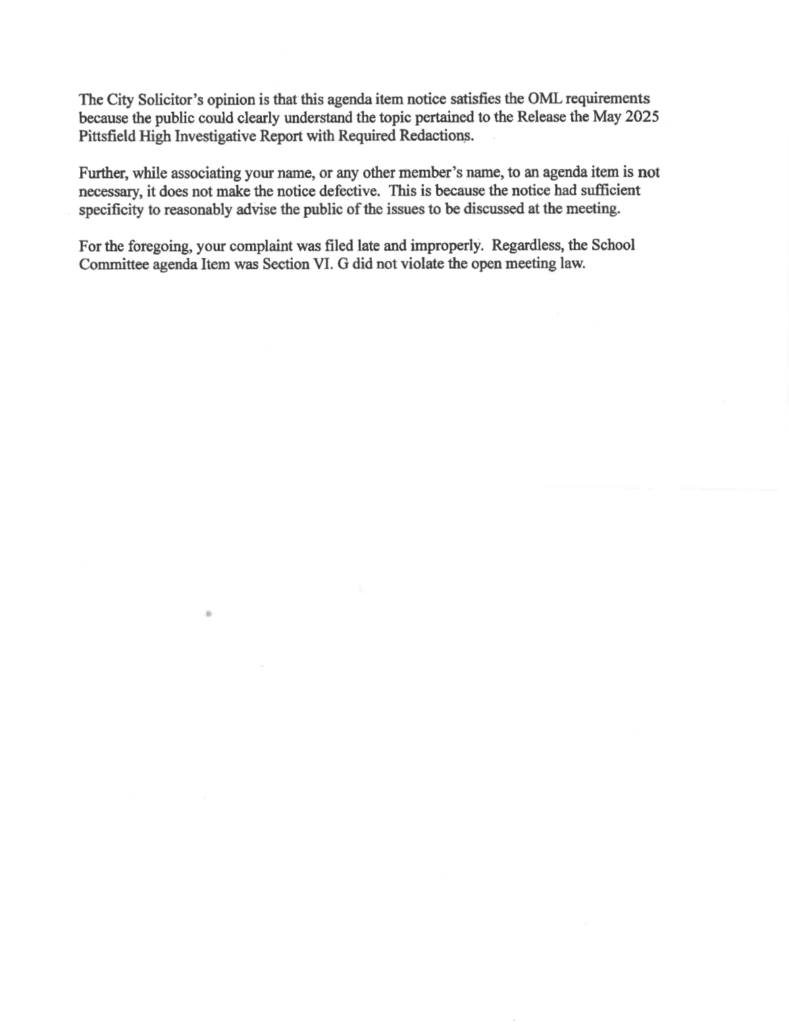
The March 25, 2026, Meeting Notice notified the public that, among other matters, the School Committee would address: “Request by Ciara Batory to Release the May 2025 Pittsfield High Investigative Report with Required Redactions.”The City Solicitor’s opinion is that this agenda item notice satisfies the OML requirements because the public could clearly understand the topic pertained to the Release the May 2025 Pittsfield High Investigative Report with Required Redactions.
Further, while associating your name, or any other member’s name, to an agenda item is not necessary, it does not make the notice defective. This is because the notice had sufficient specificity to reasonably advise the public of the issues to be discussed at the meeting.
For the foregoing, your complaint was filed late and improperly. Regardless, the School Committee agenda Item was Section VI. G did not violate the open meeting law
My Thoughts
I don’t really think there is much to add here as the City Solicitor covered most of the issues of Batory’s Open Meeting Law complaint.
The Open Meeting Law Regulations are clear that any complaint has to be submitted on the proper form (which is easily accessible on the Attorney General’s website) has to be sent to the Committee Chair and the City Clerk, and must be filed within 30 days of the violation occurring. All of which she did not do.
29.05: Complaints (1) All complaints shall be in writing, using the form approved by the Attorney General and available on the Attorney General’s website. A public body need not, and the Attorney General will not, investigate or address anonymous complaints. A public body need not address a complaint that is not signed by the complainant. A public body need not address a complaint that is not filed using the Attorney General’s complaint form.
(2) Public bodies, or the municipal clerk in the case of a local public body, should provide any person, on request, with an Open Meeting Law Complaint Form. If a paper copy is unavailable, then the public body should direct the requesting party to the Attorney General’s website, where an electronic copy of the form will be available for downloading and printing.
(3) For local public bodies, the complainant shall file the complaint with the chair of the public body, who shall disseminate copies of the complaint to the members of the public body. The complainant shall also file a copy of the complaint with the municipal clerk, who shall keep such filings in an orderly fashion for public review on request during regular business hours. For all other public bodies, the complainant shall file the complaint with the chair of the relevant public body, or if there is no chair, then with the public body.
(4) The complaint shall be filed within 30 days of the alleged violation of M.G.L. c. 30A, §§ 18 through 25, or if the alleged violation of M.G.L. c. 30A, §§ 18 through 25, could not reasonably have been known at the time it occurred, then within 30 days of the date it should reasonably have been discovered.
This complaint is pretty much going nowhere. Batory could appeal this to the Attorney General’s office, but they will most certainly dismiss it given she filed it 30 days after the supposed violation occurred. I am sure the discussion at the School Committee meeting will be interesting.
I honestly feel this isn’t an attempt at promoting transparency but to rile people up by claiming that the School Committee is “violating the law”, when there is no real basis for that claim. A better way would be to promote changes to how items appear on the agenda so it is clearer which item belongs to which individual (like the City Council does) which would address unclear agenda items like this one. However, filing an Open Meeting Law complaint (and I’m using “filing” very loosely here) is more flashy and riles people up instead of actually accomplishing anything.
I continue to be very concerned by how Batory promotes herself as being very knowledgeable on topics such as the Open Meeting Law, parliamentary procedure, and school finance, when on a closer examination she makes false statements on these topics. There were very basic procedural things she missed in trying to file this complaint that she could have easily known by searching the Open Meeting Law into Google and looking at the Attorney General’s website.
Sidenote, while I’m not 100% certain her complaint was AI written as I don’t have the original email to go off of instead of a printed then scanned copy of it, in my opinion I feel this complaint is giving off some AI writing vibes to me. The headers and bullet points that are used throughout the email and being vague about what meeting the issue occurred at and what exact part of the law was violated feels AI-like to me. The language in the “additional notice” section also seems weird, such as the phrase “copying the Clerk (or appropriate administrative office) to ensure accurate recordkeeping” which doesn’t explicitly say who the complaint is being sent to. As mentioned by the City Solicitor, the phrase “this communication is for informational purposes only and is not intended to solicit a response or engage in deliberation outside of a properly posted public meeting” does contradict how a complaint should be handled. This would track with her past uses of AI which were more discernible, though this is just how I feel.
It’s fine to say that you don’t know or are unsure about something as an elected official when trying to explain things. But when you say “I know this” which such confidence, and then are wrong about it, it becomes a problem. People become misled and small problems and mistakes become bigger issues that distract from the real issues facing the Pittsfield Public Schools such as the budget, the transition that will need to take place with closing Morningside, and addressing racism and homophobia in our schools and in our community.
I’ll end with this, people have reached out to me asking what is the best way to share their voice about their similar concerns regarding the dysfunction of the current School Committee. The best way to do that is at the public comment portion of the Committee meetings. This not only provides the opportunity to address the Committee directly, but also shows the press and the public watching that people are seeing through these false claims and want a functional School Committee again that is addressing the issues that actually affect for our students.
If you feel the same way I do, I encourage you to speak at the next School Committee meeting on Wednesday, May 27th at 6pm in City Hall Council Chambers. Make sure to get there early so you can sign up to speak.
As I have a bit more free time now that classes have ended for me, I can now address the mess that was the Participation by the School Committee section of April 29th meeting. And wow, there is a lot to address.
In all of my time following the Pittsfield School Committee, I’ve never seen any member get into a verbal yelling match with anyone at a meeting. Sure, I’ve seen it at City Council meetings and I’ve seen it by members of the public towards us, but I’ve never seen one member going after another member (or the whole group for that matter).
This disappoints and frustrates me. Good governance is one where people get along with each other, not necessarily agreeing with each other but at least can be on good terms. Good governance should be boring, not something that should be entertaining to watch. That wasn’t the case at the last meeting, and this School Committee has found itself in more shouting matches and members making themselves look good in front of the camera than I have seen in any term prior. While it seems it’s only one member causing most of the issues, I do feel there is more than one person responsible for the mess we are now in.
But before I can address what happened at the last meeting and some of incorrect information and stretches of the truth that were on display, I have to explain a few things about the operations of the School Committee and how it seems to have changed since I was on there.
The two rules that are important for this blog post are Rule 8 which discusses how the agenda gets set:
Rule 8. The Superintendent and the Chairperson of the School Committee shall prepare an agenda for each meeting of the School Committee. Such agenda shall follow the foregoing. At the discretion of the School Committee Chairperson, the agenda may be modified to accommodate school and community partner presentations. The order of business as appearing on the agenda shall not be departed from except by a vote of the majority of the members present. A Committee member shall have the right to have an item placed on the agenda, provided that such a request is made at least seven (7) days prior to the next regularly scheduled meeting.
And Rule 17 outlines the parliamentary authority the School Committee follows:
Rule 17. Robert’s Rules of Order, Newly Revised, shall be the authority adopted by the School Committee on all points, questions of debate, and parliamentary practice, when the same does not conflict with the Rules and Orders of the School Committee.
As was brought up many times during the meeting, the School Committee’s parliamentary authority is Robert’s Rules of Order, Newly Revised (RONR). This is the set of rules that governs how the School Committee conducts debate and votes on motions and actions at meetings, among others. However, the end of the rule states that RONR doesn’t apply when it conflicts with the School Committee’s own rules. Additionally, when there is a conflict between RONR and state law, state law takes priority. This comes into play with some of the restrictions the Open Meeting Law places on public bodies.
I can safely say from my time serving on many different bodies that follow RONR that most bodies do not follow all its rules regarding debate and structure. Most public bodies don’t take a vote to approve the agenda, which is a requirement that RONR has for meetings, as agenda must be posted 48 hours before the meeting starts with the Open Meeting Law. The School Committee and some other smaller public bodies don’t enforce the rule of only speaking on a motion or agenda item twice in one meeting. However, all bodies still follow RONR when it comes to making, amending, and voting on motions, and most tend to have individual members address the chair of the meeting.
Agenda Format and Submitting Items for the Agenda
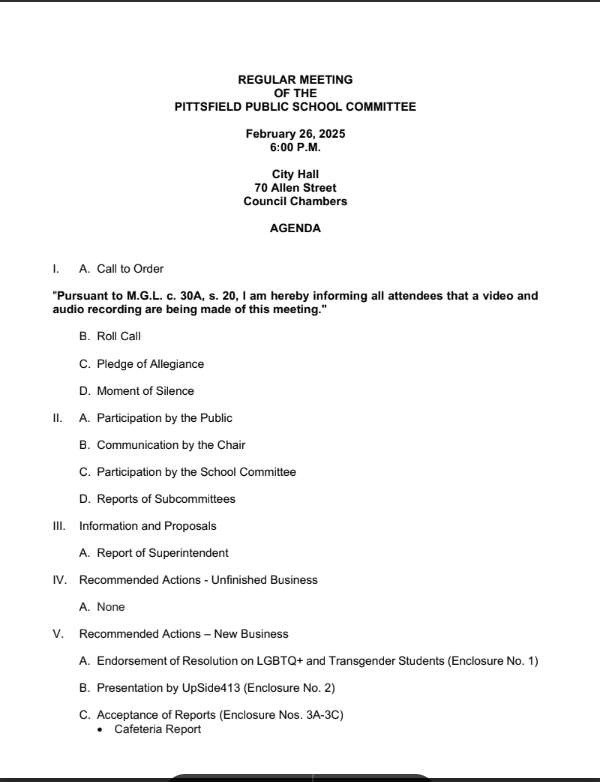
The School Committee has a less formal agenda format compared to other public bodies where it lists the items that will be discussed at the meeting, and that is it. With some more recent exceptions with this school committee which I will get to, it doesn’t list who submitted each agenda item. For example, this agenda from February 26th, 2025 where I submitted the resolution regarding LGBTQ+ and Transgender students doesn’t list that I submitted the item, only that it is on the agenda for discussion:
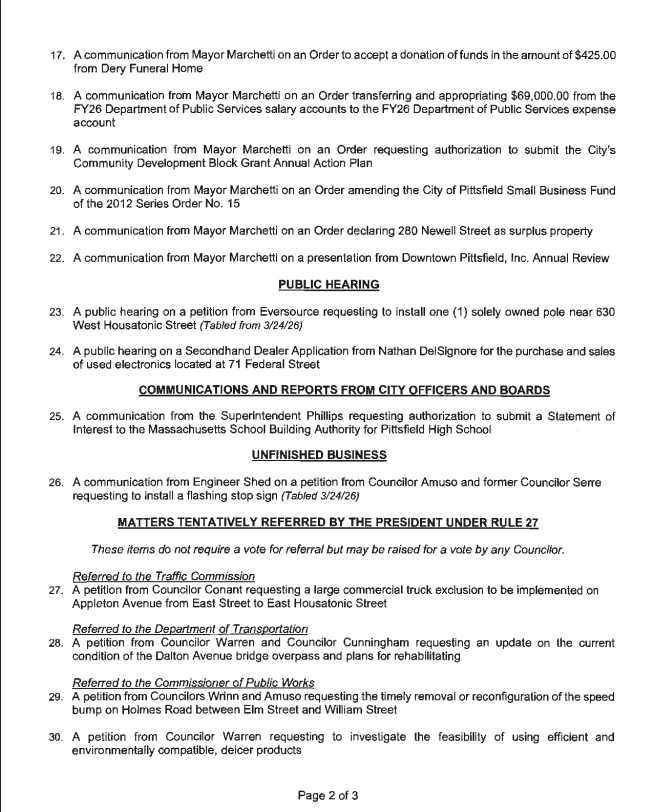
This is in contrast with the Pittsfield City Council which lists who submitted each agenda item, be it the City Administration or Councilors themselves. Each submission is either called a “communication” if it comes from the administration or a “petition” if it comes from a Councilor or a member of the public. Here is a snippet of the April 14th, 2026 agenda which shows both types of items:
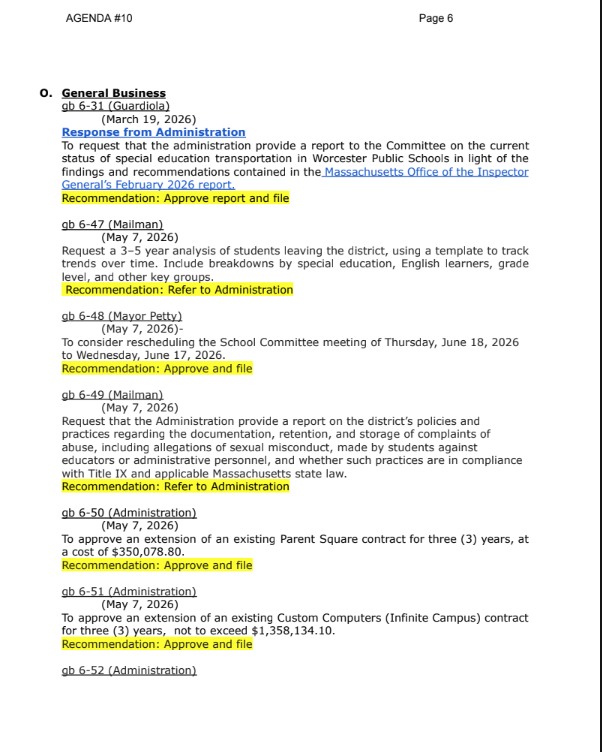
Additionally, while most school committees in the state do not do this the Worcester School Committee does list who submitted each agenda item, whether it be from members or from the administration, and a recommendation on what should happen to the item. Here is a snippet from their May 7th, 2026 agenda:
As you can see, the Pittsfield School Committee tends to be more informal on how members’ agenda item request are handled and listed on the agenda. Members reach out to the chair to put an item on the agenda, usually just for discussion with not much of a recommendation unless they are proposing something (as was the case with my resolution), and then it gets added to the agenda.
However, the current School Committee has departed from this practice, given the amount of turnover in the body as well as having a different chair. School Committee Member Batory seems to be the only member who has submitted items so far, but she has gone about it in an unusual manner. Her requests have been requests for a “motion” to be placed on the agenda, which isn’t standard practice. Members submit an item to be placed on the agenda, then during the meeting the member who requested the item can make their own motion.
Batory has so far requested 4 things during her time on the Committee:
A “motion request by Committee Member Ciara Batory to release the May 2026 Pittsfield High School Investigative Report with Required Redactions (By February 18, 2026)” at the January 28th meeting.
A “motion request by Committee Member Ciara Batory for discussion of current school event safety protocols and procedure enforcement” at the February 11th meeting.
A “Request by Ciara Batory regarding safety guidelines for participation in school-sponsored events” at the March 25th meeting.
A “Request by Ciara Batory regarding maintain Tier 1 classrooms at Capeless, Egremont, and Williams Elementary Schools where demand exists and to lift school choice restrictions when seats are available” at the March 25th meeting.
Some of these, such as the PHS report, are requests for the School Committee to consider a proposal. However, some of them are asking for a discussion to take place or for the administration to present some information at a meeting. None of these need to be submitted as “motion requests”, just regular items to be on the agenda.
What is interesting is that under Marchetti’s chairpersonship, the agendas have listed her name on the items she requested, deviating from past practice. Additionally, between February 11th and March 28th the wording changed from “motion request” to just “request”, which is more in line with what these requests are doing, though still not in line with past practice.
Addressing What Went Down
From my understanding the purpose of the Participation by the School Committee segment of the meeting is meant to allow members to talk about school events and activities they did in the past month, allow for members to make statements regarding school related issues (both good and bad), and/or ask for items to be placed on the agenda for future discussion and deliberation. It’s not meant to be a back and forth between members of the committee, nor is there meant to be any deliberation by members regarding school-related matters not on the agenda as that would be a violation of the Open Meeting Law. And for the most part, most school committee members have been respectful during this period and avoided trying to deliberate on agenda items.
That is not what happened at the last meeting.
During Batory’s turn, she questioned both the Superintendent and the Mayor regarding two matters, the closing of Morningside Community School and the PHS report, both of which were not on the agenda. And for her whole argument regarding the PHS report, it generated enough deliberation that I would go as far and say that the School Committee violated the Open Meeting Law. It was not on the agenda, yet multiple members participated in a discussion regarding the report. Marchetti, being chair and being responsible for setting the agenda and ensuring the Committee only talks about items on the agenda, should have shut down the whole discussion by saying that any further discussion would constitute a violation of the Open Meeting Law. Batory, knowing that she would bring both items for discussion, should have asked for both items to be placed on the agenda through the proper process. Both are in the wrong here, and this whole mess could have been prevented.
The Original Vote to Release a Redacted Report
One of Batory’s central arguments is that the vote the School Committee took back in January to release the PHS Investigative Report with redactions meant the report must be automatically released once the February 18th deadline hit.
At the January 28th meeting Batory made the following motion, which was seconded and approved 6-1 with Elias opposed: “I move the committee vote to release the PHS Investigation Report in a redacted form by February 18th, 2026, and I’d like the add that the School Committee reviews it before it’s released to the public to make sure that there is enough to present to the public.” It was the interpretation of several members of the Committee that they would review the redacted report and determine if there was enough information to warrant release to the public. Additionally, Marchetti stated “It won’t be released until the School Committee has approved that version”, which nobody including Batory raised an objection to.
Batory is now claiming that motion means the redacted report must be released, no matter what, once the February 18th deadline has passed. But that doesn’t line up with the original intent of the vote. Her original motion had the School Committee be able to review the redacted report to make sure “there is enough to present to the public”, implying that the Committee would be the ones to decide what is considered “enough to present to the public” through another vote. It wouldn’t make sense if the Committee found there wasn’t enough to present, or if anything that they could present would get the Committee into a lawsuit that they would most certainly lose, but the redacted report would get released anyways just because an arbitrary deadline passed. I’m also certain that is the interpretation of both the Committee’s legal counsel and the legal counsel for the Massachusetts Teachers Association, because if it wasn’t the MTA would have already launched a lawsuit against the School Committee as they have threatened to do if any version of the report is released.
Batory claims that a “motion is not a motion to make another motion, that makes no sense”, yet that is how it works. Motions can, and often do, lead to other motions having to be made at some point in the future. When the Committee hires for any position, it makes a motion to offer the appointment to the individual and then a few meetings later makes a motion to approve a contract of employment with that person. With Morningside, the Committee made a motion to close down Morningside, which will then require the School Committee to make a motion and vote on new elementary school attendance zones without Morningside. This is the case with Batory’s original motion, the Committee voted to request a redacted version of the PHS report, and the Committee will then have to make a future motion on whether or not there is enough information to release to the public.
Now, could the original motion have been clearer? Yes, I think adding any mention of a deadline is ripe for confusion and unneeded conflict. While I still think the intent of the motion would have been the same, the original motion could have been clearer by saying that the School Committee would get the redacted report for review by February 18th, or when it was ready for review by legal counsel if the process took longer.
Additionally, the Committee hasn’t voted to decide whether there is enough information to be released. The Committee went into executive session regarding the reports on both March 11th and March 25th, but both times the only vote taken was to approve the minutes of the prior executive session meeting. I think the intent of the agenda item on the March 25th meeting was to vote on whether or not to release the report, but that did not happen as no member made a motion to take any action on the redacted report. If the Committee wants to clear things up, it should take a vote on whether or not the report as redacted by legal counsel should be released at a future meeting to end this whole debacle.
The Poorly Worded Agenda Item
Batory’s other central argument was that Mayor Marchetti put an item on the agenda “under her name” regarding the PHS report for the March 25th meeting, which was listed as “Request by Ciara Batory to release the May 2025 Pittsfield High School Investigative Report with Required Redactions”, appearing under the new business section. There is also an effort in some parts of the Pittsfield Facebook sphere to have people send letters to the State Ethics Commission calming that Marchetti abused his position as chair as he “authored and/or submitted a motion that appeared under the name of School Committee member Ciara Batory”. However, I feel this is stretching the truth quite a bit.
First, the State Ethics Commission has no oversight here. They primarily focus on violations of the Conflict of Interest Law, which deals with normal conflict of interest matters such as issues around government employee’s family members and financial interests. They do not focus on issues that arise of the internal operations of a public body, such as how items are added and displayed on the agenda and how meetings are run. Improper wording of a motion or the allegation of submitting a motion under another person’s name does not fall under the Conflict of Interest Law. So I’m certain that will go nowhere and is only being promoted to rile people up online.
Second, as I mentioned earlier, School Committee members don’t submit motions to be placed on the agenda, they submit agenda items. Additionally, past practice until really this new Committee came along was that agenda items do not have the person’s name who requested them attached to it. So, an agenda item isn’t truly attributable to one person.
It seems Marchetti’s intent in wording the agenda item this way was to have a discussion on Batory’s past request for the PHS reports to be released, not that Batory requested to have a discussion about releasing the report, which does make sense. However, the agenda item should have been worded better to show that intent. As the item was listed after two other items that Batory requested to be on the agenda that both began with “Request by Ciara Batory”, a reasonable person would have assumed that the PHS report item was a request by her. Further, as this item was a discussion on a previous action it really should have been placed under unfinished business as it would be discussing an action that the Committee has not taken yet. Finally, as the Committee voted to approve Batory’s motion to release a redacted version of the PHS report, it’s no longer Batory’s request but the Committee’s request, which should have been reflected in the agenda item. A better worded agenda item could have been “Update on Request to Release the May 2025 Pittsfield High School Investigative Report with Required Redactions”, which would have avoided this mess.
In short, do I believe Marchetti made a poor wording choice in how this item appeared on the agenda? Yes, I do, it should have been worded differently to truly reflect the intent of the discussion. Do I believe this was an abuse of power and that an agenda item was wrongly submitted under Batory’s name? No. Hanlon’s razor applies very well here: “Never attribute to malice that which is adequately explained by stupidity.”
Parliamentary Procedure
Batory also brought up RONR several times during her argument and that the Committee was not following RONR properly, claiming that she “read the rules and I write motions and I study the rules”. However, I feel she presented several claims that were false about parliamentary procedure and additionally did not follow it herself, as well as some misunderstandings about how a committee should work together.
First, per RONR when a member has the floor, they address the chair and the chair only. Batory directed comments and questions to other members of the school committee, such as when asking if each member read the full PHS report and if they have any ties to any of the individuals mentioned in the report. That is not permissible as she cannot direct comments towards other members like that under RONR, such comments and questions must be directed through the chair.
Additionally, Batory incorrectly stated that Member Muil cannot make a motion to rescind the prior vote regarding the PHS report as she was not “on the opposing side”. There are two types of motions that can be made to rescind a prior motion, a motion to reconsider and a motion to rescind a prior motion. A motion to reconsider allows a body to reconsider a motion it made earlier during the same meeting; however it can only be made by someone on the prevailing side of the motion, not the opposing side as Batory mentioned. Reconsideration doesn’t apply here as the original motion was voted on meetings ago. The only way the Committee can undo the vote is through a motion to rescind, which can be made by any member of the body. Luckily, this was clarified in the meeting, but as a person who knows quite a bit about parliamentary procedure it was frustrating to hear this claim aired in a meeting by someone who claims to know “the rules”.
Finally, Batory made the argument that the goal of the Committee is to not work as a team, but to represent the public. Additionally, she criticized how the other members of the Committee all vote the same, stating: “How is that even possible? What are the odds”. Working as a team doesn’t mean you will all agree in the same way, but it does mean that everyone treats each other with respect and understanding and offers different points of view. Further, after the committee has decided on a certain matter all members have an obligation to support the decision of the majority and try not to undermine it.
During my time on the committee, I was a part of many dissenting votes, including some 6-1 votes. I didn’t get into shouting matches with my colleagues, and I didn’t raise my voice at anyone. I shared my disagreements, made suggestions on where practices could be clearer, and moved on. We had a good group of people where we could work out issues to ensure that everyone could vote yes on a certain motion or issue and help to make processes better. When Marchetti raised concerns about how we approve the personnel report, I made a suggestion to change the motion to “accept and place on file”, making everyone satisfied. The job of the committee should be to problem solve and work together to resolve issues and make processes clearer, not put up fights and make statements that look good for the TV cameras and the Facebook comment section.
So, Where Should the Committee Go From Here
Based on all of this, I believe the Committee should do the following:
First, all members should understand the Open Meeting Law and that if they want to discuss something during a meeting, they should request an item to be placed on the agenda through the existing process.
Second, the wording of agenda items should be made clearer to show the intent of the item on the agenda. This mess the Committee found itself in was preventable if agenda items were better worded. Honestly, I feel the Committee should no longer put members’ names next to items that are requested as this has been a deviation from past practice and seems to create more conflict and confusion.
Third, if the Committee wants to clear up the whole releasing the redacted version of the PHS report, it should take one of two actions:
The Committee should hold another vote in public session to determine whether or not to release the redacted version of the PHS report based on if there is enough information in it to warrant it being released. This would be in line with the intent of the January 28th motion to release the report.
To really clear things up, the Committee could also vote to rescind the January 28th motion entirely. This would end the whole issue on releasing the report as it would be treated like no motion was made in the first place.
It does not seem like this discussion will be taking place at the meeting on Wednesday, May 13th even though it was implied during the last meeting that it will. I’m not fully sure of the reason, though it would be a violation of the Open Meeting Law if the discussion came up during Participation by the School Committee again, which I feel like will happen given Batory and others are trying to get people to come out to the meeting. Thus, it would have to come up at a future meeting.
Some Final Thoughts
This dysfunction and mess that the current School Committee found itself in is what I feared with 5 out of the 7 School Committee members being new this term, a new chair, a mostly new Superintendent cabinet, and a new Superintendent and School Committee executive secretary. There is so much turnover that a lot of the processes, practices, and lessons learned from prior School Committees and other district matters are not getting passed along, causing conflict and confusion. This is what happens when there is a lot of turnover.
While her original post (which now has been taken down) made false claims about Pittsfield’s Net School Spending requirement, her argument was that the City should be contributing more to educational spending and one way that should be done is through the use of free cash.
As a nonrecurring revenue source, free cash should be restricted to paying one-time expenditures, funding capital projects, or replenishing other reserves. We do not recommend that free cash be budgeted for ongoing operational purposes.
This is the fundamental problem with using free cash, or really any nonrecurring revenue sources for educational spending. Most educational spending is recurring spending, mainly salaries for teachers and staff. Unless reductions in force are made, salaries will grow year after year by a mostly predictable amount. Free cash, meanwhile, does not grow by a predictable amount year after year. Some years we may have more free cash, and other years we may only have a little bit.
Let’s say the city wants to give $4,000,000 from free cash to the Schools to help eliminate any cuts to staff this year. There is no guarantee that the city will still have $4,000,000 to give to the schools next year from free cash, and so the district will have to make the same cuts next year, maybe even more cuts because salaries would have gone up more, especially since that negotiations are still ongoing with all 3 bargaining units. This would cause more instability in the school budget and create more issues down the road for the district.
Now, could the city give the schools some free cash funds to help pay for some non-recurring expenses such as repairs to buildings, new textbooks, or new supplies. Probably, depending on the financial picture of the city. Though I think the City tries to be careful with not using up too much free cash in case an emergency comes up and the city needs to move funds out of free cash to pay for it.
However, I think we are looking at the wrong side of the education funding formula here.
If we take a deeper dive into spending over require Net School Spending for all districts in Massachusetts, we see a bit of a pattern emerge. Municipalities that are wealthier can fund their schools more compared to municipalities that are not as wealthy.
Here are the 20 districts who budgeted the most above the Required Net School Spending in FY26. As you can see, there are towns and cities such as Lenox, Richmond, and Cambridge that tend to be more wealthier and can afford to put more money into their schools.
Ranking Over NSS
District Name
FY26 Required NSS
FY26 Budgeted NSS
Amt Over or Under Req’d
Budgeted as % of Req’d
1
Provincetown
1,696,815
8,843,829
7,147,014
521.2%
2
Truro
2,240,515
7,328,234
5,087,719
327.1%
3
Upisland
5,407,027
17,515,002
12,107,975
323.9%
4
Pelham
994,542
2,944,843
1,950,301
296.1%
5
Rowe
738,129
2,156,313
1,418,184
292.1%
6
Richmond
2,029,918
5,491,621
3,461,703
270.5%
7
Lenox
6,840,967
18,175,047
11,334,080
265.7%
8
Edgartown
6,443,899
15,970,838
9,526,939
247.8%
9
Rockport
8,017,687
19,604,925
11,587,238
244.5%
10
Cambridge
129,510,667
299,094,537
169,583,870
230.9%
11
New Salem Wendell
1,726,325
3,754,387
2,028,062
217.5%
12
Pioneer Valley
9,260,407
20,135,553
10,875,146
217.4%
13
Erving
2,653,776
5,766,563
3,112,787
217.3%
14
Concord
24,705,221
52,595,437
27,890,216
212.9%
15
Wellesley
55,002,556
116,199,671
61,197,115
211.3%
16
Oak Bluffs
7,008,100
14,627,041
7,618,941
208.7%
17
Mattapoisett
5,011,904
10,256,911
5,245,007
204.7%
18
Tisbury
6,777,327
13,833,985
7,056,658
204.1%
19
Whately
1,318,482
2,676,030
1,357,548
203.0%
20
Topsfield
7,207,299
14,575,928
7,368,629
202.2%
Here the 20 districts who budgeted the least over Required Net School Spending in FY26 (if they meet it at all). As you can see, there are towns and cities such as Springfield, Fitchburg, Worcester, and Holyoke that are less wealthier and cannot afford to put much more in that what is required for their schools.
Ranking Over NSS
District Name
FY26 Required NSS
FY26 Budgeted NSS
Amt Over or Under Req’d
Budgeted as % of Req’d
296
Greater Lawrence
51,977,920
50,255,643
(1,722,278)
96.7%
295
Northbridge
32,816,827
31,729,457
(1,087,369)
96.7%
294
Malden
132,114,202
128,253,528
(3,860,674)
97.1%
293
Holbrook
23,413,602
22,943,763
(469,839)
98.0%
292
Greater Lowell
55,719,987
55,468,222
(251,765)
99.5%
291
Tri County
22,245,823
22,171,098
(74,725)
99.7%
290
New Bedford
295,054,095
294,825,036
(229,059)
99.9%
289
Greater Fall River
35,109,152
35,109,152
0
100.0%
288
Leominster
111,313,888
111,318,708
4,820
100.0%
287
Springfield
600,170,350
600,237,749
67,399
100.0%
286
Lynn
384,629,299
384,684,153
54,854
100.0%
285
Southeastern
38,826,302
38,842,804
16,502
100.0%
284
Northeast Metropolitan
34,438,284
34,526,132
87,848
100.3%
283
Essex North Shore
31,042,516
31,133,830
91,314
100.3%
282
Holyoke
124,458,254
124,931,826
473,573
100.4%
281
Everett
172,711,735
173,457,122
745,387
100.4%
280
Worcester
549,403,109
552,004,676
2,601,567
100.5%
279
Gardner
45,038,410
45,258,504
220,094
100.5%
278
Southbridge
44,392,356
44,621,778
229,422
100.5%
277
Fitchburg
110,732,185
111,423,878
691,693
100.6%
Pittsfield ranks 216 on spending over Required Net School Spending, which is on the lower side compared to other districts.
One of the goals of the Student Opportunity Act was to give more funding to school districts who needed more funding to their schools but couldn’t afford it out of their tax base, ensuring all districts are equitably funded. But if wealthier districts can put more money into their schools and be able to provide more services, then that inequity still exists.
I feel the state needs to reexamine the Chapter 70 funding formal again, instead of making smaller fixes like increasing minimum per-pupil aid each year which doesn’t address any of these inequities. I feel the state should look at ensuring that inflation and cost increases that districts face are represented in the foundation budget, instead of using an inflation factor that doesn’t match reality. The state should also look at finding ways to ensure that districts that can’t get more funding from their local governments can get more state aid so they are not outspent by districts that do have the means to spend more towards education.
And honestly, using AI to do things for you as a School Committee member is pretty bad and frustrating.
Earlier today (or yesterday depending on when you are reading this) School Committee Member Batory made this post on Facebook:
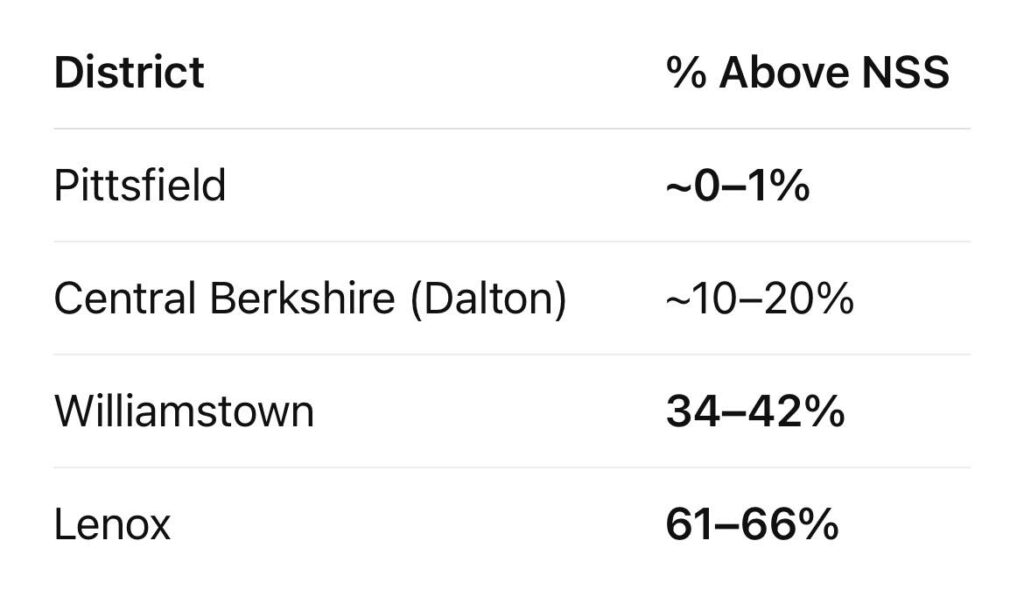
Right now, Pittsfield is funding its schools at about 1% above the state minimum requirement.
Let that sink in.
Meanwhile, surrounding districts are making very different choices:
• Lenox invests over 60% above the minimum
• Williamstown invests over 30% above the minimum
• Central Berkshire (Dalton area) invests 10–20% above the minimum
And here in Pittsfield?
We are essentially funding our schools at the floor.
At the same time, the city recently placed millions into free cash instead of directing more resources into classrooms.
This is not about what we can afford.
This is about what we are choosing to prioritize.
Net School Spending is supposed to be the starting point — not the finish line.
If we want stronger schools, better outcomes, and to keep families in this district, we cannot continue doing the bare minimum and expecting maximum results.
Democracy only works when people participate.
Show up. Speak out. Be heard.
(This post reflects my personal views, not those of the full School Committee.)
Table included in Member Batory’s post
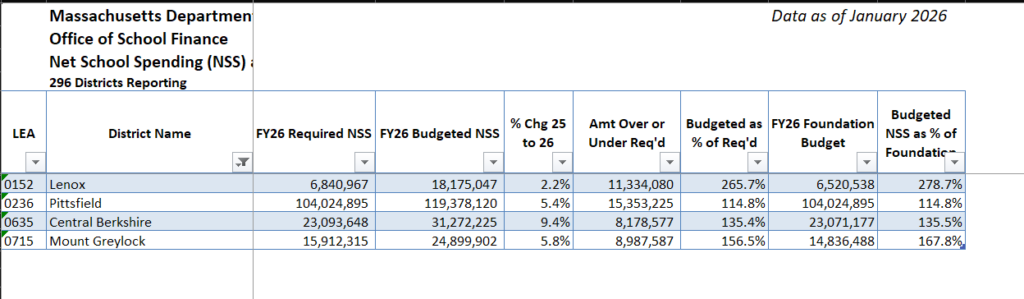
So, this post is pretty inaccurate. In FY26 Pittsfield required Net School Spending requirement was $104,024,895, the budgeted NSS was $119,378,120, which is around 14.75% over what is required. It’s definitely not 1%. The percentages are also not correct for Lenox, Central Berkshire, and Mount Greylock (Williamstown IS NOT it’s own district). Here is some data from the Department of Elementary and Secondary Education Net School Spending Report with the correct percentages and numbers for FY26.
Based on how this post was written and a lot of her past posts are written, I’m 100% certain this was a post created by ChatGPT. Here’s why:
Her post uses a some emojis and em dashes, which are unusual for a Facebook post and is a sign the post was AI generated.
The data table lists Williamstown as a district, which it isn’t as it is a part of Mount Greylock.
For Pittsfield and Central Berkshire the table has a “~” before the range, meaning its an estimate, which doesn’t make sense as the calculation between percentage over net school spending would not be an estimate but the actual number. Williamstown and Lenox do not have the “~” before them.
The ranges for the percentages are not equal, but also there shouldn’t be need for a range when reporting the percentage over net school spending, unless you are looking over a certain period of time which is also not reported in the table.
The source link she provided in the comments has “?utm_source=chatgpt.com” appended to the end, meaning it was a link ChatGPT gave out. It also points to some old data on net school spending, with the page reporting 2022 data.
I get the argument that the city needs to spend more on schools, and there is a lot of debate and discussion that needs to be had regarding school funding for Pittsfield, which I won’t touch on here. However, any debate needs to have ACCURATEhuman verified information. This is not helpful and is actually harmful for our school community.
Local elected officials are the most trustedelected officials in the country, people believe their local officials more than Congress. With the increase of social media usage by local officials and the decrease in local news, local elected officials have taken on the role of providing information about local matters to their constituents. With this role comes the responsibility to provide accurate and verified information to the best of their ability.
This post by School Committee Member Batory goes against this. Artificial intelligence models are known to output wrong information and hallucinate. That’s why it’s best practice to use AI responsibly and ethically by verifying the output and making sure the information is correct. I personally don’t use AI much, but when I do I make sure the information it provides is correct. In my view Batory failed to responsibly verify this information. Whether intentional or unintentional such irresponsibility only fuels more distrust in our government institutions, especially when such inaccurate information is stated with such confidence. It also wastes people’s energy debating important issues such as school funding when the foundational facts of such debate are incorrect. If you go to the post and check out the comments and shares, there is already a lot of debate about her post, but nobody is refuting the misinformation that she helped to spread.
As a resident of Pittsfield, I’m frustrated by the disregard for basic fact checking and the ethical responsibilities she has as a School Committee member. As a former School Committee member who put a lot of time into understanding the role and the functioning of school systems and admit when I don’t fully understand something, I’m flabbergasted by the complete disregard for taking the time to fully understand the role rather than just typing prompts into ChatGPT and taking what is says as gospel. Being a School Committee member takes time and commitment that cannot and should not be outsourced to AI. This is Trump level behavior, and Pittsfield and our students deserve better than this.
This isn’t the first time I’ve seen inaccurate and unverified AI information from Batory, and I’m certain this won’t be the last. There is a lot more I could say on this subject, but I think this is enough for one blog post.
This blog post is based off a Facebook post I made on my personal account back in January when the Governor’s budget came out, with some additional details based on feedback and new information I’ve received. Hoping to do more blog posts on the school budget because I have a lot of thoughts and a lot of information to share, once I finish weeding through all of the numbers and data.
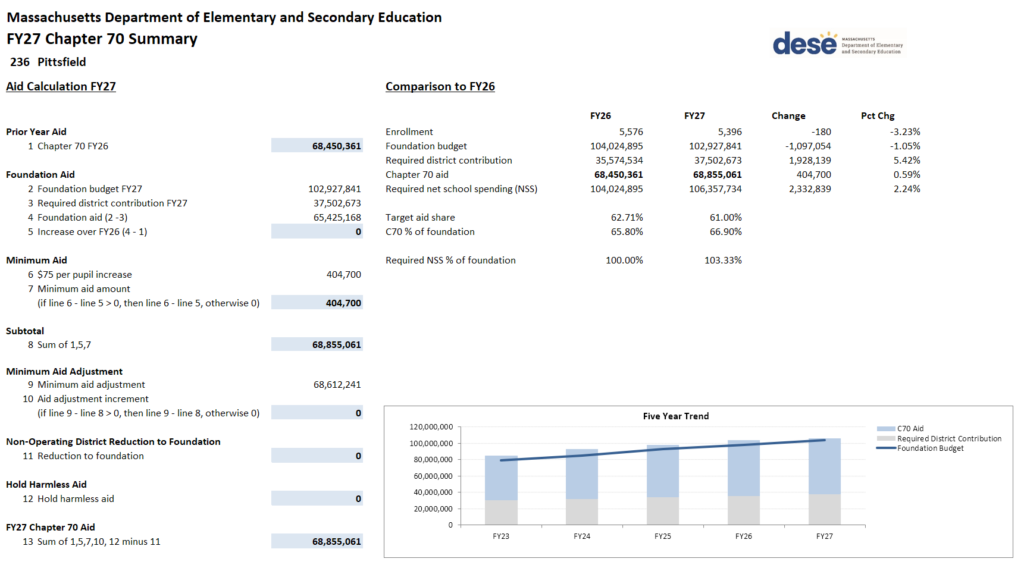
As has been reported wildly, the Pittsfield Public Schools is only getting an increase of $404,700 in Chapter 70 state aid. This is much lower compared to past fiscal years where increases were at least a few million dollars.
Taking a deeper look at the numbers for Pittsfield under the proposed Governor’s budget, it seems like the small increase of only $404,700 is due to the following factors:
1. The inflation rate is 2.76%, with an insurance inflation rate of 8.29%. This does not reflect the actual inflation we are seeing in schools.
1. A decrease in foundation enrollment of 180 students compared to last fiscal year. The foundation enrollment number measures the number of school age children living in Pittsfield, not the number of students enrolled in the district. So this number declined because the number of children living in Pittsfield has gone down, not because of changes to enrollment due to school choice. This is an issue we are seeing both in Berkshire County and statewide. Thank you to former School Committee Chair Dr. Cameron for pointing that out to me.
2. Chapter 70 groups districts based on the percentage of low income students enrolled in the district, with districts having a higher percentage of low income student receiving more Chapter 70 funding. Pittsfield has been in group 11 for the past few years, between 70% and 79.99% low income students. However we slipped down into group 10 with 68.95% low income students. Some may recall that the district back in 2024 was initially put in group 10 under the Governor’s proposed budget, but after Assistant Superintendent Behnke noticed that the state’s count of low income students was undercounting the number of low income students in Pittsfield, future budget proposals brought us back into group 11.
3. The required municipal contribution, the amount the state believes Pittsfield can pay for its school system out of local dollars (property taxes) increased by $1,928,139. The City gives PPS more local funding than what is required by the state, but this increase means we get less Chapter 70 funding. Additionally, this means that the City does not have to increase its local contribution to the PPS line item, which is what they are doing this year (planning to do a whole blog post on that soon).
What is interesting is that because of these 3 factors, the regular Chapter 70 formula when calculated would actually give us less state aid than last year. Because that is not allowed by Chapter 70, we enter something called “hold harmless”, where we get the same amount of aid as we did last year + $75 increase per pupil in the district. As our enrollment is 5,396 students, if you times that by $75 you get $404,700.
The sort of good thing I guess about being in hold harmless with the minimum per pupil increase is that the legislature tends to increase the $75 number. Last fiscal year they increased it to $150 per pupil. Under that number the district would receive a $809,400 increase in Chapter 70. So it would be reasonable to assume the Legislature might try to do that again, even though it doesn’t address the root issue of increasing the inflation rate to account for actual inflation.
Take this information with a grain of salt, a lot of things are simplified here as Chapter 70 is complicated (as I keep learning as I try diving more into the numbers). I’m not a Chapter 70 expert by any means and this is just my impressions of the figures for Pittsfield.
I’m not going to get into my thoughts about this, partially because that itself deserves its own blog post that I’m not sure I’m ready to write just yet. However, I want to push back on an argument Councilor Warren made in supporting this vote that “there is no confusion in the publics vote in the November election, they want transparency” (page 11 of the City Council packet that contained the minutes of this meeting), inferring that the voters wanted the report released and voted accordingly in the election.
I do not buy this argument as I believe the voters were not given much of a choice this past election. Most of the candidates either supported releasing the report (Batory, Muil, Buerger, Smith, and Barry) or didn’t say much about their support or opposition (Klein and McNeice). There were only two candidates who supported the past School Committee’s decision to not release the full PHS, Elias (who ultimately voted against the motion to release the report) and Yon (while she supported the motion she seemed to support the Committee’s handling of PHS during the election). If voters wanted to elect School Committee members that were happy with how the School Committee handled the PHS incidents, then they were out of luck.
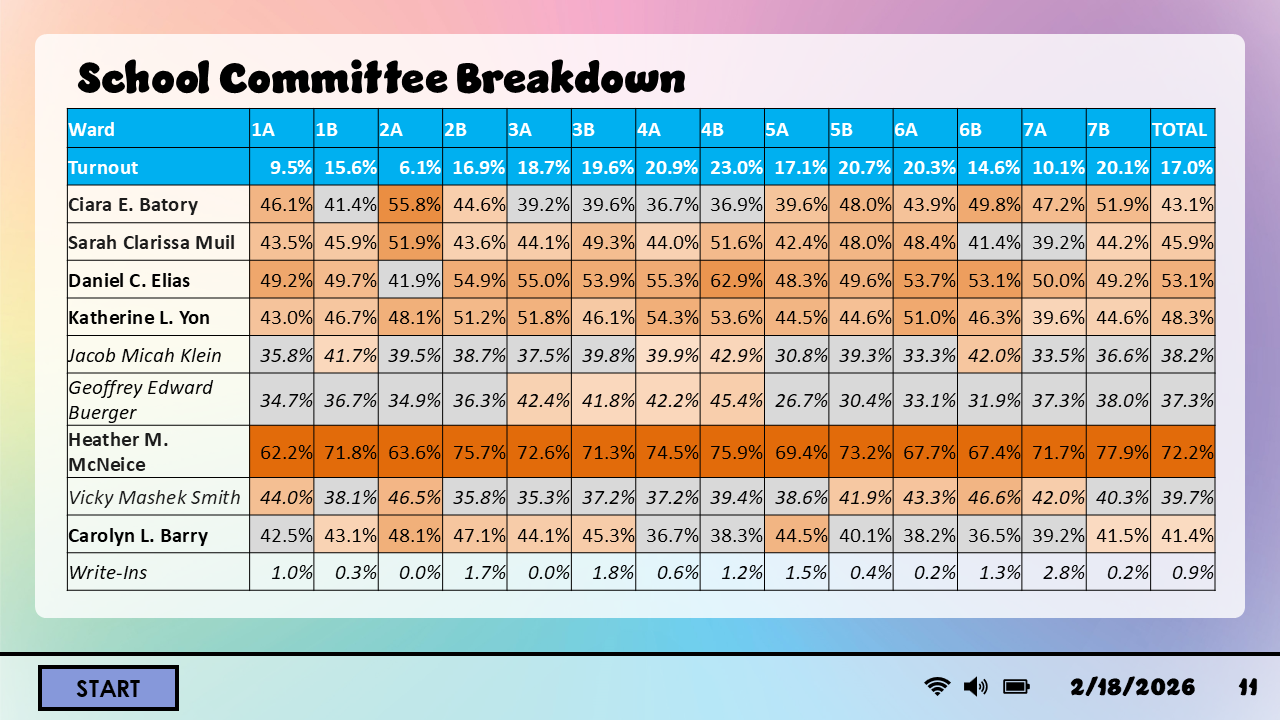
This argument also falls apart when you take a deeper look at the election results, which is what I did for a talk I gave to the MCLA Political Science Club.
As you can see, McNeice was the highest vote getter, and was the highest vote getter in every precinct. I would argue that this support came from being very well known in the community for being a long time Taconic teacher. In 2nd and 3rd place overall were Elias and Yon. Already this refutes the claim that the voters were clear about their views on the PHS report because if that were the case then Elias and Yon wouldn’t have been high up, if elected at all.
But to get a better understanding of this support, you need to look deeper. Looking at the second place winner in each precinct, Elias was the 2nd place winner in every precinct except for 2B, where he was in 7th place, and 7B where he was in 3rd place. In both of those precincts Batory was the 2nd place winner. If there was true, widespread support of releasing the full PHS report and dislike of the School Committee’s handling of the PHS incidents, then Elias would have not been the 2nd place winner in these many precincts.
Taking a look at the 3rd place winners in each precinct, Yon was the 3rd place winner in 6 precincts, 1B, 2B, 3A, 4A, 4B, and 6A, and tied with Barry in 5A. Batory was the 3rd place winner in 3 precincts, 1A, 6B, and 7A, and tied with Muil in 5B. Muil was the 3rd place winner in 2 precincts, 2A and 3B, and ties with Batory in 5B. Elias was the 3rd place winner in 7B. I feel these results show a more mixed picture of what voters wanted in a School Committee in this election.
Additionally, if you take a look at Sara Hathaway’s numbers in her unsuccessful at-large councilor bid, she got 2761 votes, more votes than every school committee candidate except for McNeice and Elias. If voters were this dissatisfied with the former School Committee’s handling of the PHS reports, Hathaway would have not had such a large vote count even for an at-large councilor seat.
Ultimately, I think these election results really show two common themes in local politics: voters tend to prefer incumbents and familiar faces. No incumbent lost their seat this last election, and in the 2023 Pittsfield election only one incumbent lost their seat. For the amount of criticism both the city government and the school department get on places such as Facebook and the Berkshire Eagle, voters who show up to vote tend to be happy with the current state of local government in Pittsfield. I don’t feel these results really show support for any certain agenda or mandate to do something, voters just like stability and familiar faces in government.
 We are essentially funding our schools at the floor.
 Democracy only works when people participate.