This blog post is based off a Facebook post I made on my personal account back in January when the Governor’s budget came out, with some additional details based on feedback and new information I’ve received. Hoping to do more blog posts on the school budget because I have a lot of thoughts and a lot of information to share, once I finish weeding through all of the numbers and data.
As has been reported wildly, the Pittsfield Public Schools is only getting an increase of $404,700 in Chapter 70 state aid. This is much lower compared to past fiscal years where increases were at least a few million dollars.
Taking a deeper look at the numbers for Pittsfield under the proposed Governor’s budget, it seems like the small increase of only $404,700 is due to the following factors:
1. The inflation rate is 2.76%, with an insurance inflation rate of 8.29%. This does not reflect the actual inflation we are seeing in schools.
1. A decrease in foundation enrollment of 180 students compared to last fiscal year. The foundation enrollment number measures the number of school age children living in Pittsfield, not the number of students enrolled in the district. So this number declined because the number of children living in Pittsfield has gone down, not because of changes to enrollment due to school choice. This is an issue we are seeing both in Berkshire County and statewide. Thank you to former School Committee Chair Dr. Cameron for pointing that out to me.
2. Chapter 70 groups districts based on the percentage of low income students enrolled in the district, with districts having a higher percentage of low income student receiving more Chapter 70 funding. Pittsfield has been in group 11 for the past few years, between 70% and 79.99% low income students. However we slipped down into group 10 with 68.95% low income students. Some may recall that the district back in 2024 was initially put in group 10 under the Governor’s proposed budget, but after Assistant Superintendent Behnke noticed that the state’s count of low income students was undercounting the number of low income students in Pittsfield, future budget proposals brought us back into group 11.
3. The required municipal contribution, the amount the state believes Pittsfield can pay for its school system out of local dollars (property taxes) increased by $1,928,139. The City gives PPS more local funding than what is required by the state, but this increase means we get less Chapter 70 funding. Additionally, this means that the City does not have to increase its local contribution to the PPS line item, which is what they are doing this year (planning to do a whole blog post on that soon).
What is interesting is that because of these 3 factors, the regular Chapter 70 formula when calculated would actually give us less state aid than last year. Because that is not allowed by Chapter 70, we enter something called “hold harmless”, where we get the same amount of aid as we did last year + $75 increase per pupil in the district. As our enrollment is 5,396 students, if you times that by $75 you get $404,700.
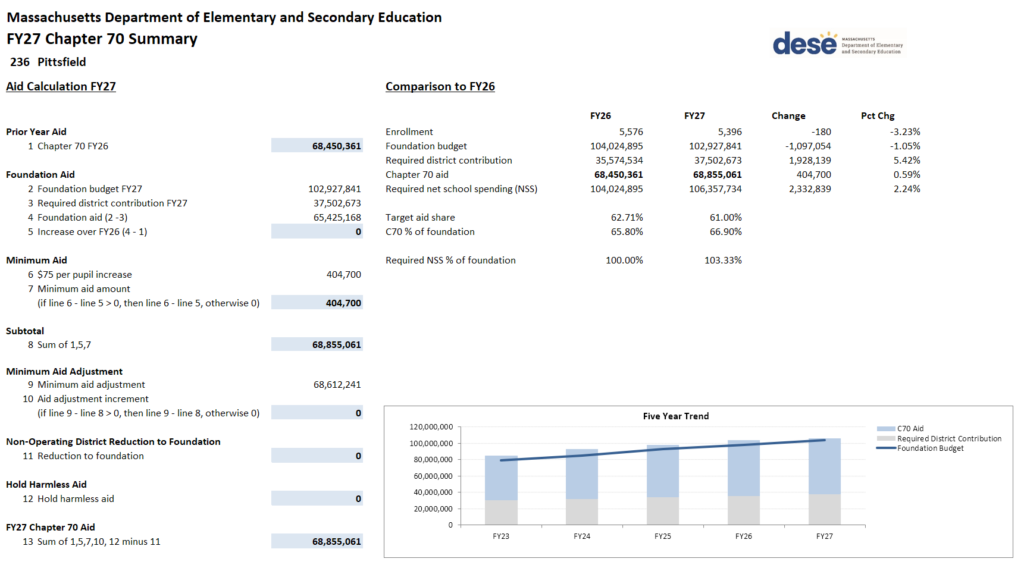
The sort of good thing I guess about being in hold harmless with the minimum per pupil increase is that the legislature tends to increase the $75 number. Last fiscal year they increased it to $150 per pupil. Under that number the district would receive a $809,400 increase in Chapter 70. So it would be reasonable to assume the Legislature might try to do that again, even though it doesn’t address the root issue of increasing the inflation rate to account for actual inflation.
Take this information with a grain of salt, a lot of things are simplified here as Chapter 70 is complicated (as I keep learning as I try diving more into the numbers). I’m not a Chapter 70 expert by any means and this is just my impressions of the figures for Pittsfield.